
If you’re running Google Ads in the UAE and haven’t fully explored Performance Max (PMax), you’re leaving serious conversions — and dirhams — on the table. This guide walks UAE businesses through everything they need to know about PMax in 2026: what it is, how to set it up, how to optimize it, and how to use it strategically in a competitive market like Dubai, Abu Dhabi, Sharjah, Ajman, Fujairah, Umm al Quwain, and Ras al Khaimah.
Table of Contents
Table of Contents
What Is Google Performance Max in 2026?
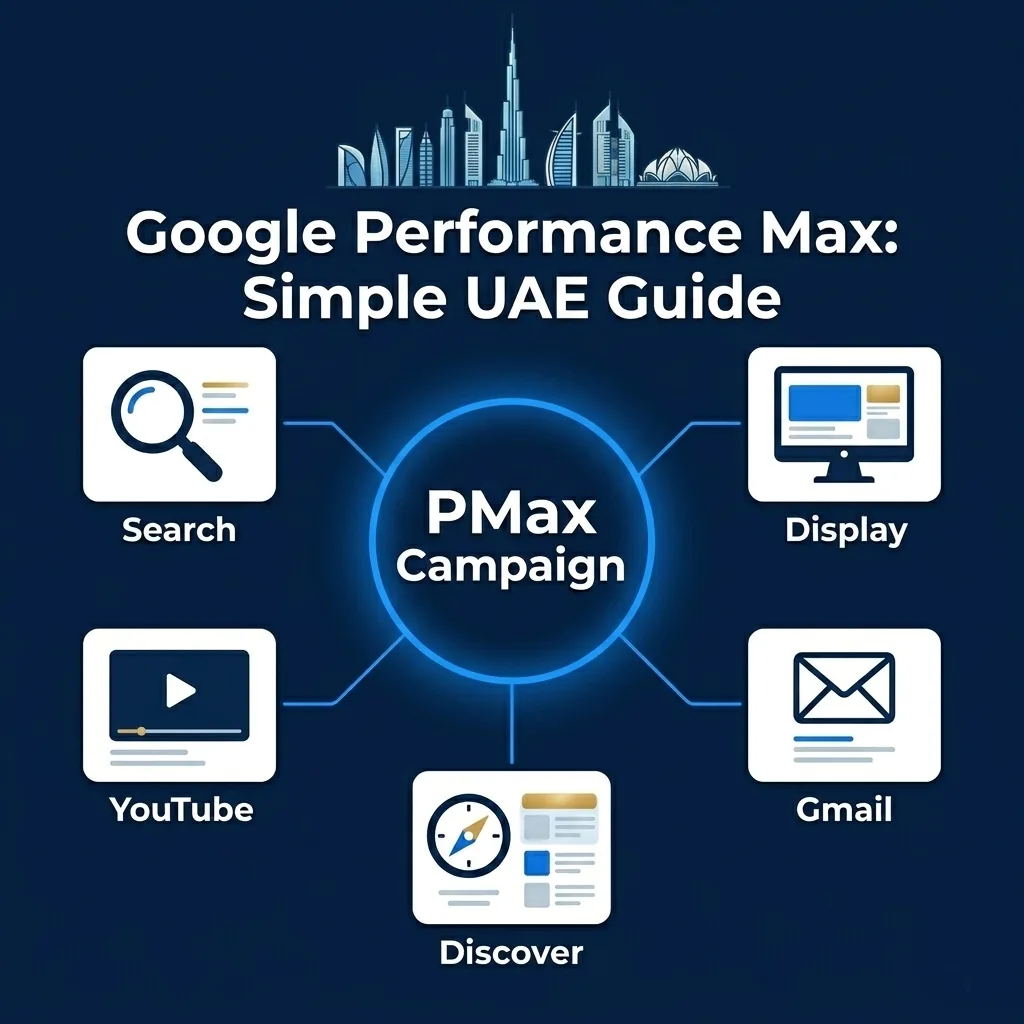
Performance Max (PMax) is Google’s AI-driven, goal-based campaign type that gives advertisers access to all of Google’s inventory — Search, Display, YouTube, Discover, Gmail, and Google Maps — from a single campaign. Instead of managing individual campaigns for each channel, PMax uses machine learning to determine where, when, and to whom to show your ads based on your conversion goals.
In 2026, PMax has matured significantly. Google has added more transparency features, including better search term reporting, asset-level performance breakdowns, and deeper audience insights. It’s no longer a “black box” — it’s a powerful automation layer built on top of your data.
How PMax Works Behind the Scenes
PMax uses a combination of your asset groups (creatives, headlines, videos, images), audience signals, conversion data, and Google’s own real-time intent signals to serve ads wherever they’re most likely to drive your goal. The system learns continuously, automatically shifting budget across channels, devices, and audiences.
PMax vs Traditional Search & Display
| Feature | PMax | Traditional Search/Display |
|---|---|---|
| Channels | All Google channels | Single channel |
| Keyword control | Limited (audience signals) | Full keyword targeting |
| Creative flexibility | Requires multiple asset types | Single ad format |
| Automation level | High (AI-driven) | Low to medium |
| Best for | Scale + conversions | Precision + control |
Why PMax Matters for UAE Businesses
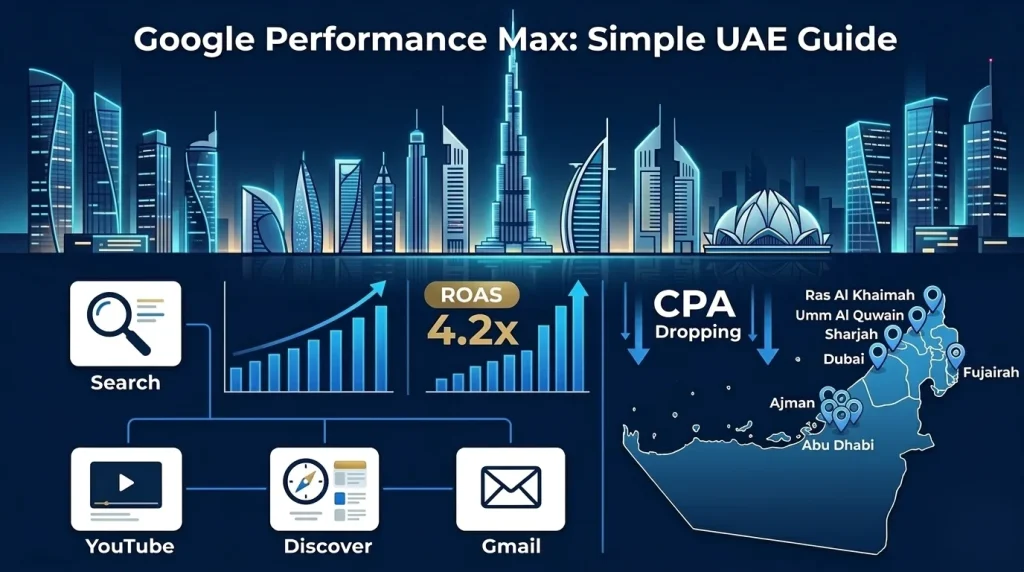
The UAE digital advertising market is one of the most competitive in the MENA region. CPCs in Dubai for industries such as real estate, healthcare, legal services, and finance can be exceptionally high. AI-driven bidding through PMax helps squeeze the most value from every dirham by dynamically allocating budget where it performs best across channels.
AI Advantage in Competitive UAE Markets
When you’re competing against dozens of agencies and brands for the same keyword in Dubai, manual bidding simply can’t react fast enough. PMax’s Smart Bidding uses real-time signals — device, location, time of day, audience intent — to set the optimal bid for every impression. This is critical in UAE markets where user behavior varies significantly between morning browsing, lunchtime mobile scrolling, and late-night decision-making.
Full-Funnel Reach for Local and Global Audiences
UAE businesses often need to reach both local residents and international visitors or investors. A real estate developer in Dubai targets both UAE nationals buying family villas and overseas investors. PMax can serve YouTube video ads to an overseas investor browsing property, a Display ad to a local user comparing developers, and a Search ad to someone actively typing “buy apartment Dubai” — all within the same campaign, optimized for the same conversion goal.
When to Use (and Not Use) PMax
PMax is not for every situation. Knowing when to deploy it — and when to hold back — is the mark of a smart advertiser.
Best Use Cases for PMax in the UAE
- You have solid conversion tracking set up (leads, sales, calls, WhatsApp clicks, store visits)
- You have historical Google Ads data with at least 30–50 conversions per month
- You have multiple creative assets available (images, videos, headlines, descriptions)
- You’re targeting broad goals: more leads, more eCommerce sales, more store visits
- You want to scale beyond Search into YouTube, Display, and Discover without managing separate campaigns
Situations Where Standard Search Is Better
- You need tight query control (very niche B2B keywords, highly specific legal or medical terms)
- You’re launching a brand-new account with zero conversion history
- Your creative assets are very limited (no videos, minimal images)
- Your conversion tracking is incomplete or unverified
- You want to test specific messages with high keyword-level transparency
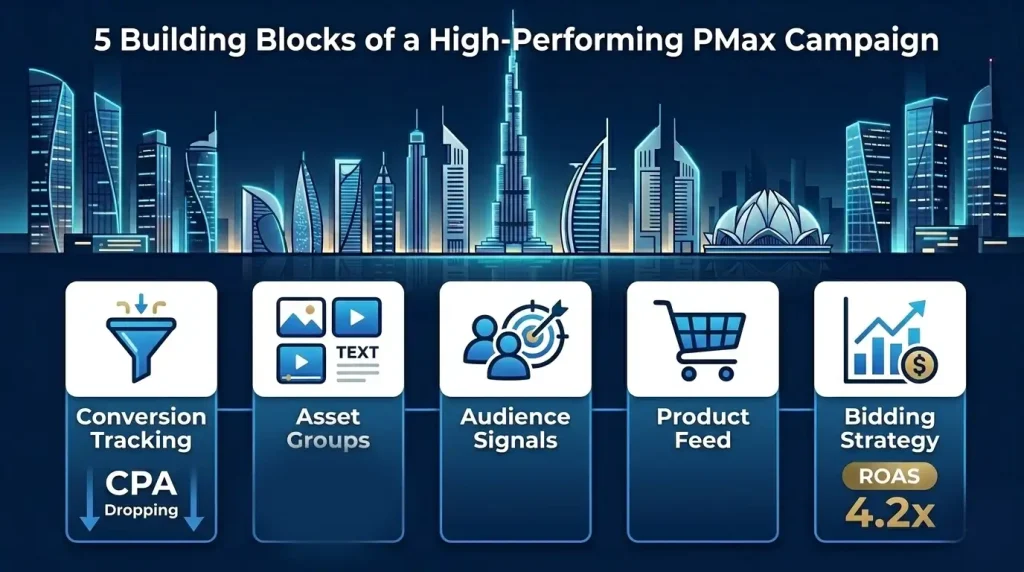
Essential Building Blocks of a PMax Campaign
Before you launch, make sure each component is solid. A PMax campaign is only as good as the foundations you build it on.
Conversion Tracking and Data Quality
This is the most critical element. PMax needs to know what success looks like. Set up all relevant conversion actions — form submissions, phone calls, WhatsApp button clicks, purchase completions, and (for retailers) in-store visits. Use Google’s Enhanced Conversions to pass hashed first-party data back to Google for more accurate reporting. Without clean conversion data, PMax will optimize toward the wrong signals and waste your budget.
Asset Groups and Creatives
An asset group is the collection of creative elements that PMax mixes and matches to build ads across all channels. Each asset group should include:
- 5 headlines (30 characters each)
- 5 long headlines (90 characters each)
- 4 descriptions (90 characters each)
- Up to 20 images (landscape, square, portrait formats)
- Logo (multiple aspect ratios)
- At least 1 video (YouTube-hosted; 10–30 seconds recommended)
- Sitelinks, callouts, and call extensions
For UAE businesses, localize your asset groups. Use Arabic headlines if you’re targeting Arabic-speaking audiences. Feature UAE-specific social proof (“Trusted by 500+ Dubai businesses”), local landmarks, or Emirate-specific CTAs.
Audience Signals (Not Hard Targets)
Audience signals are suggestions you provide to Google’s AI to help it start learning faster — they are not strict restrictions. Strong signals to include:
- Your own website visitor remarketing lists
- CRM customer lists (existing clients)
- Custom intent segments built from your best-performing search keywords
- In-market audiences (e.g., “In-market for real estate in UAE”, “interested in beauty and personal care”)
The more quality signals you provide, the faster PMax learns. Think of it as giving the AI a head start.
Feeds and Product Data (for E-Commerce)
If you run an online store in the UAE, connect your Google Merchant Center feed to PMax. The campaign will use your product titles, images, prices, and availability to build Shopping-format ads automatically. Ensure your feed is optimized — clean titles with keywords, high-resolution images, accurate pricing in AED, and proper GTIN codes.
Bidding and Budget Strategy
PMax supports Maximize Conversions (with or without a target CPA) and Maximize Conversion Value (with or without a target ROAS). For new campaigns, start with Maximize Conversions without a hard tCPA target to allow the algorithm to gather data. After 4–6 weeks and at least 30–50 conversions, introduce a tCPA or tROAS target.
For budget, think about what you’d want to spend on a campaign covering Search + Display + YouTube combined. If you read our guide on how much to spend on Google Ads in Dubai, use those benchmarks as your starting point before letting PMax optimize within those limits.
Step-by-Step: Setting Up a High-Performing PMax Campaign
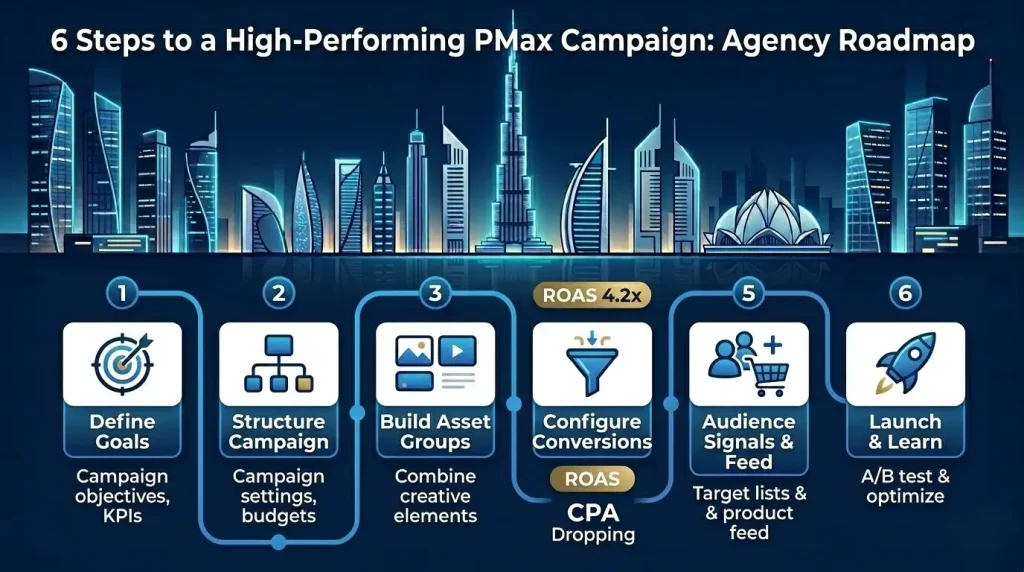
Step 1: Clarify Business Goals and KPIs
Before creating the campaign, define exactly what success looks like:
- Lead generation: Form fills, calls, WhatsApp inquiries
- E-commerce: Purchase completions, revenue, ROAS
- Local foot traffic: Store visits, calls, direction requests
- Bookings: Appointment scheduling, reservation completions
Your goal determines your conversion setup and bidding strategy.
Step 2: Structure Campaigns Around Goals, Locations, and Products
Avoid putting every product or service into one campaign. Instead, structure by:
- Goal type: Separate lead gen from sales campaigns
- Geography: UAE-wide campaigns vs Emirate-specific (Dubai, Sharjah, Abu Dhabi, RAK)
- Product/service line: E.g., one PMax for villa sales, another for apartment rentals
This gives you cleaner data and more meaningful optimization insights.
Step 3: Build Strong Asset Groups
Create separate asset groups for different themes or audiences. For example, a clinic in Dubai might have:
- Asset Group 1: General health checkups (English, Dubai audience)
- Asset Group 2: Specialized dental services (English + Arabic, Sharjah audience)
- Asset Group 3: Pediatric care (English, families in Abu Dhabi)
Each asset group should have its own tailored messaging, creatives, and audience signals.
Step 4: Configure Conversion Tracking and Bidding
Go into your Google Ads settings and verify that all conversion actions are:
- Correctly tagged on your website
- Set to “Primary” (not “Secondary”) for the conversions you want PMax to optimize
- Using Enhanced Conversions where possible
- Tracking calls with a minimum call duration (e.g., 30–60 seconds) to filter out wrong numbers
Step 5: Set Up Audience Signals and Feeds
Upload your customer list from your CRM. Build custom segments using high-intent search terms (“best property developer Dubai”, “dental implants cost Dubai”, “corporate catering Dubai”). Add your remarketing lists. If running eCommerce, connect your Merchant Center feed and enable product groups within the asset group.
Step 6: Launch, Learn, and Respect the Learning Period
After launch, PMax enters a learning phase typically lasting 2–4 weeks. During this time:
- Do not change budgets drastically (±20% maximum at a time)
- Do not change bidding strategies
- Do not pause or delete asset groups
- Do monitor impressions, clicks, and conversion trends without intervening early
Patience during the learning phase is one of the most important — and most commonly ignored — rules of PMax.
Advanced Optimization Strategies for 2026
Once your campaign is past the learning phase and generating stable results, these are the levers to pull.
Using Insights and Search Term Data
In your PMax campaign, navigate to the Insights tab. Here you’ll find:
- Search categories: Broad categories of search queries triggering your ads
- Audience insights: Who is converting (demographics, interests)
- Asset performance: Which headlines, descriptions, and images get “Best”, “Good”, or “Low” performance ratings
Use search categories to identify irrelevant themes and add them as account-level negative keywords. Promote winning audience patterns into your custom segments.
Negative Keywords and Brand Protection
PMax does not support campaign-level negative keywords the same way Search does. However, you can:
- Add account-level negative keywords to block queries you never want to appear for
- Apply a brand campaign exclusion so PMax doesn’t cannibalize your dedicated Brand Search campaigns
- Request a brand exclusion via your Google Ads representative to protect competitor name terms
This is especially important in UAE markets where “cheap” or “free” queries often drive unqualified traffic.
Creative Testing Within Asset Groups
Google labels each asset’s performance as Best, Good, Low, or Pending. Replace “Low” performing assets regularly — every 4–6 weeks. During key UAE seasonal moments (Ramadan, Eid, Dubai Shopping Festival, UAE National Day, summer staycation promotions), create dedicated asset groups with season-specific messaging and offers. Localized, timely creatives consistently outperform generic evergreen ads.
Geo and Store-Level Optimization
For businesses with physical locations across the UAE, use:
- Location exclusions to remove areas outside your service radius
- Radius targeting around your store or clinic
- Store visit conversion tracking (available if your business has enough foot traffic volume)
- Google Business Profile linking to unlock location extensions and Maps placements
First-Party Data and Offline Conversions
For high-ticket industries — real estate, B2B services, luxury hospitality — the online form fill is just the beginning. Import offline conversion data back into Google Ads. When a lead from your PMax campaign closes as a property sale or long-term contract in your CRM, upload that data. PMax will learn to find more users who resemble your actual closed clients, dramatically improving lead quality over time.
PMax Playbooks for Key UAE Verticals
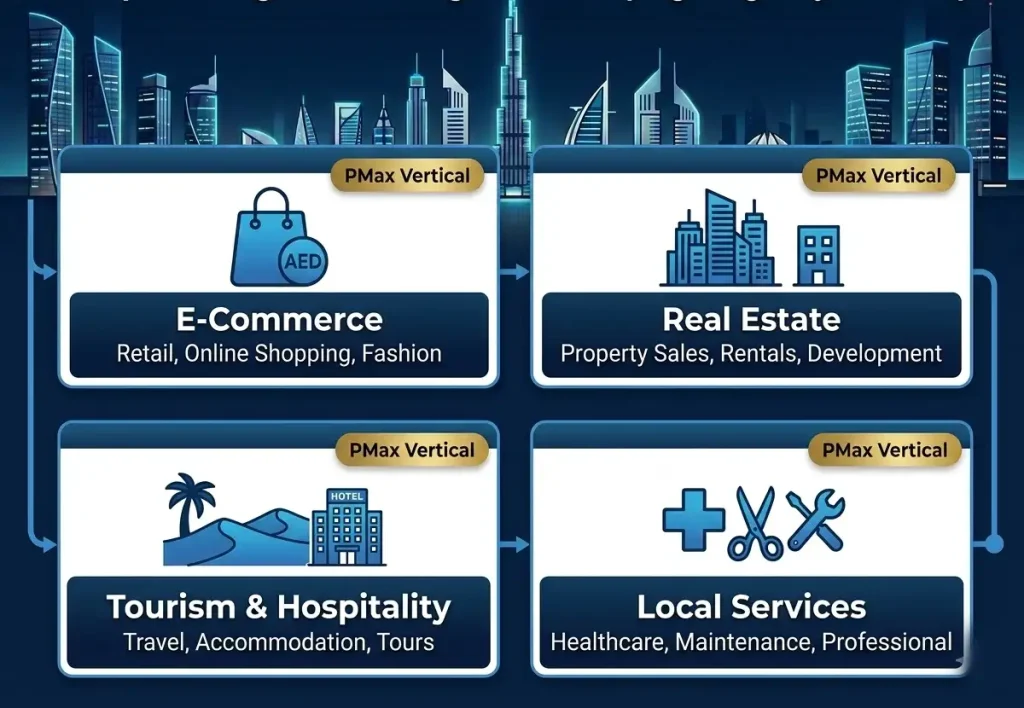
E-Commerce Brands in Dubai and Across the UAE
Goal: Revenue and ROAS
Setup: Connect Merchant Center feed + asset groups with lifestyle product imagery + customer purchase list as audience signal
Key move: Enable “New Customer Acquisition Goal” to push PMax toward finding buyers who haven’t purchased from you before — a great tool for UAE brands looking to grow their customer base beyond repeat buyers
KPI to watch: ROAS, revenue per asset group, cart abandonment (remarket via asset group)
Real Estate and Property Developers
Goal: Qualified lead form fills + phone calls
Setup: Strong video assets (virtual tours, project walkthroughs), Arabic and English asset groups, CRM customer list upload, custom segments using high-intent search terms
Key move: Set a realistic tCPA based on your average cost per qualified lead, not just any form fill. Use offline conversion import to tell Google which leads became actual sales
KPI to watch: Cost per qualified lead, call duration, lead-to-site-visit conversion rate
Tourism, Hospitality, and Experiences
Goal: Bookings, reservations, inquiry form fills
Setup: High-quality image and video assets of experiences/venues, seasonal asset group variants, geo-targeting toward international traveler hubs (airports, hotels), Discover and YouTube placements emphasized
Key move: Run PMax alongside a dedicated Search campaign for high-intent queries like “desert safari Dubai booking” or “staycation Dubai 2026 offer” so you capture both the awareness stage (PMax) and the decision stage (Search)
KPI to watch: Cost per booking, revenue per campaign, seasonal ROAS fluctuations
Local Service Businesses (Clinics, Salons, Home Services)
Goal: Phone calls, appointment bookings, direction requests
Setup: Location extensions + Google Business Profile linked, call conversion tracking with minimum duration, asset groups in both English and Arabic
Key move: Use store visit and call-from-ads conversion tracking as primary goals rather than just form fills. Many UAE service customers prefer calling directly
KPI to watch: Cost per call, call-to-appointment conversion rate, store visit data
Common Mistakes UAE Advertisers Make with PMax
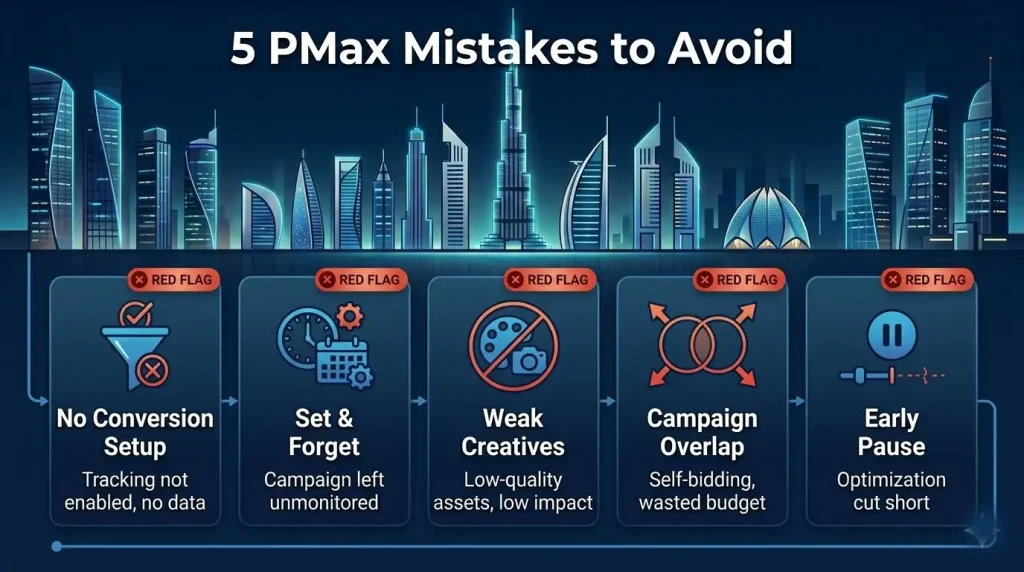
1. Launching Without Clean Conversion Tracking
The mistake: Setting up PMax with “All conversions” including bounces, page views, or soft engagements.
The fix: Audit your conversion actions before launch. Mark only meaningful conversions (leads, purchases, calls) as “Primary”. Everything else goes to “Secondary”.
2. Treating PMax as “Set and Forget”
The mistake: Launching the campaign and not checking back for weeks or months.
The fix: Review your Insights tab weekly. Refresh “Low” performing assets monthly. Check search categories for irrelevant traffic and update negatives quarterly.
3. Weak Creatives and No Video Assets
The mistake: Uploading only one or two images and no video.
The fix: Google will auto-generate a video from your images if you don’t provide one — and auto-generated videos are almost always low quality. Create a simple 15–30 second branded video for your asset group, even if it’s just a professional slideshow with voiceover.
4. Overlapping Campaigns Competing for the Same Goal
The mistake: Running PMax and a standard Display or Shopping campaign with the same goal and audience.
The fix: Pause legacy campaigns gradually once PMax proves it can deliver. Run them simultaneously only during the learning phase for data comparison, then consolidate.
5. Killing Campaigns Before the Learning Phase Ends
The mistake: Seeing high CPCs or few conversions in week one and pausing the campaign.
The fix: Commit to at least 4 full weeks before evaluating performance. The learning phase requires data — cutting it short resets the clock and wastes your initial budget investment.
How PMax Fits into Your Google Ads Strategy with Prontosys
Performance Max is not a replacement for your entire Google Ads strategy — it’s the centerpiece of a layered, full-funnel system. When you understand why Google Advertising is key to business growth, you begin to see PMax for what it is: the scaling engine, while Search remains your precision tool for high-intent queries.
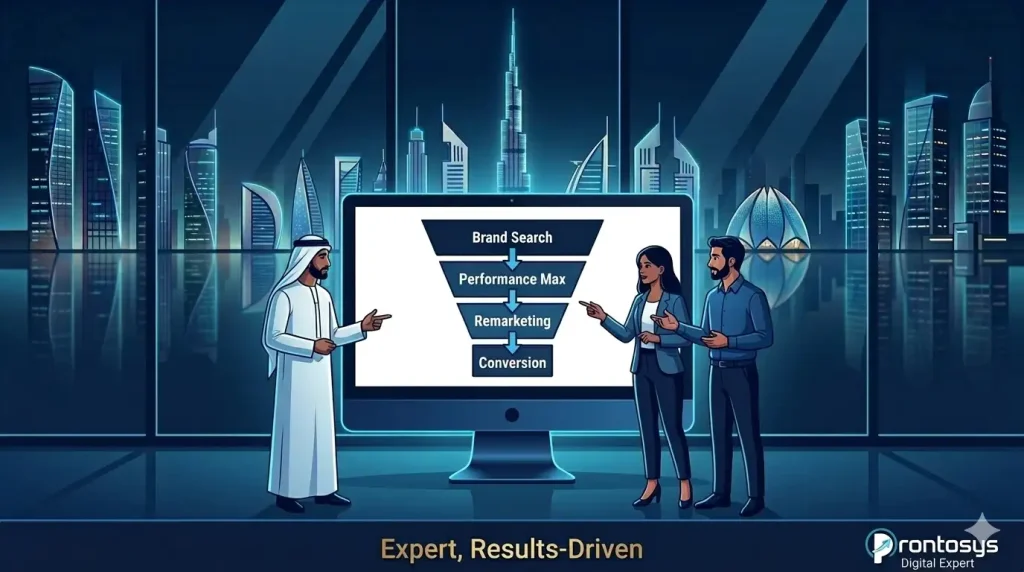
Layering PMax with Search and Remarketing
A mature Google Ads strategy for UAE businesses typically looks like this:
- Brand Search Campaign: Protects your brand name, captures high-intent navigational queries
- Performance Max Campaign: Scales reach across all channels, drives conversions at volume
- Remarketing (DSA or Display): Re-engages visitors who didn’t convert yet (though PMax handles some of this, dedicated remarketing campaigns can be more efficient for warm audiences)
This layered approach ensures you’re present at every stage of the customer journey — from first awareness to final conversion.
When to Scale PMax Budgets (And When Not To)
Scale your PMax budget when:
- ROAS or CPA has been consistently hitting the target for 3+ consecutive weeks
- The Insights tab shows strong asset performance and clean search categories
- Conversion volume is growing month-over-month
Hold off on scaling when:
- You’re still in the learning phase
- Conversion tracking is showing anomalies (sudden spikes or drops)
- CPA has crept above the target for two or more weeks in a row
Why Work with a Certified Google Partner for PMax
PMax’s power comes with complexity. The decisions around campaign structure, asset group segmentation, audience signal strategy, negative keyword management, and bidding require deep expertise. Getting it wrong doesn’t just mean missed performance — it means burning budget while Google’s AI optimizes for the wrong signals.
As a Certified Google Partner in the UAE, Prontosys manages PMax campaigns across multiple industries — real estate, eCommerce, healthcare, tourism, and local services — with conversion-first structures, rigorous creative testing, and transparent monthly reporting. Whether you’re in Dubai, Sharjah, Abu Dhabi, Ajman, Umm al Quwain, Fujairah, or Ras Al Khaimah, our team knows the local market and can build a PMax strategy that actually works.
FAQ: Performance Max for UAE Businesses
Is Performance Max worth it for small UAE businesses?
Yes — but only if your conversion tracking is solid and you have a clear, measurable goal. Small businesses with limited budgets (AED 3,000–8,000/month) should start with a focused tCPA target and one or two clear conversion actions. Avoid spreading across too many asset groups early on.
How long does a PMax campaign take to optimize?
Expect a 2–4 week learning phase, followed by 4–6 more weeks of gradual optimization. Most PMax campaigns reach stable, target-hitting performance within 6–8 weeks. Resist the urge to make major changes before then.
Can I control which keywords my PMax campaign shows for?
Not directly. PMax doesn’t support traditional keyword targeting. You can influence query coverage through audience signals (custom intent segments built from keyword themes) and limit irrelevant queries through account-level negative keywords and the search category exclusions available in the Insights tab.
Should I run Performance Max and Search campaigns together?
Yes, in most cases. Your Brand Search campaign should always run alongside PMax to protect brand terms. For non-brand queries, run a supporting Search campaign for your most critical high-intent terms. PMax can handle broader awareness and multi-channel reach while Search handles precision.
What budget should I start with for PMax in Dubai?
A minimum of AED 5,000–8,000 per month is recommended to generate enough conversion data for the algorithm to optimize. For more competitive verticals (real estate, medical, legal), start at AED 10,000+ to stay competitive with CPCs. Read our Google Ads budget guide for Dubai for a full breakdown by industry.
Ready to launch a Performance Max campaign that actually converts? Contact Prontosys — UAE’s certified Google Partner, Google Ads Expert in Dubai — and let’s build your PMax strategy from the ground up.

Vijit Tyagi is the CEO and Founder of ProntoSys, a global digital marketing and IT services agency headquartered in Dubai. A B.Tech graduate in Computer Science from Dr. A.P.J. Abdul Kalam Technical University, he brings over 15 years of industry experience. Under his leadership, ProntoSys has expanded across the UAE, UK, and India, becoming a certified Google Partner with a team of 120+ professionals. Tyagi focuses on client-centric digital solutions, ROI-driven strategies, and helping businesses adopt effective digital transformation. He also contributes thought-leadership articles on digital marketing in major publications, emphasizing innovation and growth for modern businesses.