
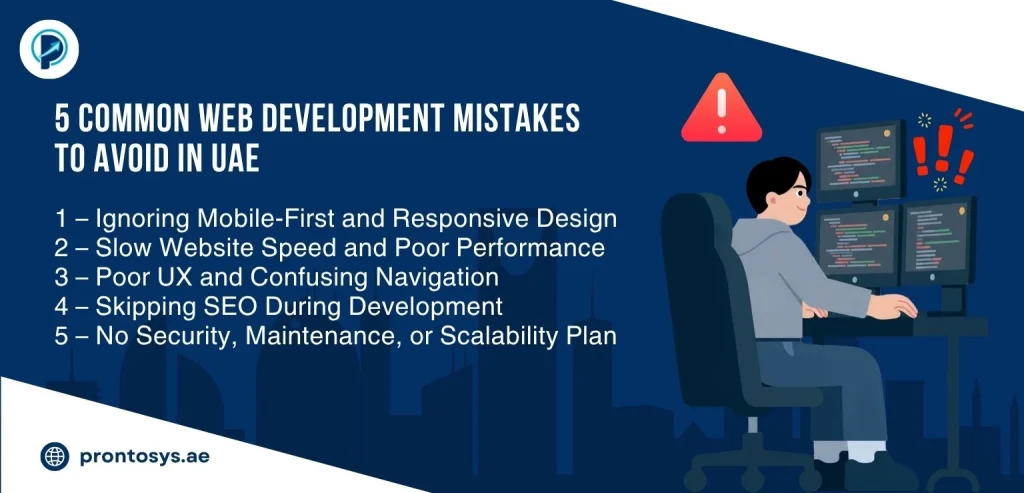
Avoid costly errors in web development that can impact your site’s performance and user experience with these tips tailored for businesses in UAE.
Building a website for your UAE business is one of the most important digital investments you will make. But too often, businesses rush into development without a solid strategy — and end up with a site that looks decent but fails to generate leads, rank on Google, or convert visitors. Whether you are launching a new website or planning a redesign, understanding the most common web development mistakes will save you time, money, and frustration.
In this blog, we cover five critical mistakes UAE businesses make during web development — and how a professional website development company in Dubai can help you avoid all of them.
Table of Contents
Table of Contents
Mistake 1 – Ignoring Mobile-First and Responsive Design
In the UAE, over 75% of internet users access websites from their smartphones. Despite this, many businesses still launch websites that are designed primarily for desktop screens — leaving mobile users with broken layouts, tiny text, and frustrating navigation.
A non-responsive website not only damages user experience but also hurts your search rankings. Google uses mobile-first indexing, which means it primarily looks at the mobile version of your site when determining where to rank you in search results. If your site is not optimised for mobile, you are invisible to a large portion of your target audience.
Common signs of this mistake include:
- Text that requires pinching and zooming to read
- Buttons or menus that overlap or are too small to tap
- Images that break or overflow on smaller screens
- Slow loading times on mobile networks
How to Fix It
Work with a web development team that builds mobile-first by default. Use responsive frameworks like Bootstrap or CSS Grid that automatically adapt layouts to different screen sizes. Regularly test your website on multiple devices — Android, iPhone, tablet — and use tools like Google’s Mobile-Friendly Test and PageSpeed Insights to identify issues early.
Mistake 2 – Slow Website Speed and Poor Performance
Page speed is not just a technical issue — it directly impacts how many visitors stay on your site, how many convert, and how high you rank on Google. Research consistently shows that a one-second delay in page load time can reduce conversions by up to 7%. In a competitive market like Dubai, where users have high expectations, a slow website is a serious business liability.
The most common causes of slow websites include:
- Unoptimised, oversized images
- Too many third-party scripts (chat widgets, pixels, trackers)
- No browser caching or content delivery network (CDN)
- Shared cheap hosting that cannot handle traffic spikes
- Bloated code, unused CSS/JS files, and theme overhead
This is especially critical for businesses running Google Ads — a slow landing page directly lowers your Quality Score and increases your cost-per-click.
How to Fix It
Optimise all images before uploading using tools like TinyPNG or WebP format. Minify your CSS, JavaScript, and HTML files. Enable browser caching and use a CDN to serve content faster to users in different locations across the UAE. Choose quality hosting suited to your website’s traffic volume.
Better still, partner with a web development company in Dubai that builds performance-optimised websites from day one, integrating Core Web Vitals best practices during the development phase rather than trying to patch issues after launch.
Mistake 3 – Poor UX and Confusing Navigation
A website that looks beautiful but confuses visitors is a missed opportunity. Poor user experience (UX) is one of the top reasons businesses lose potential leads online. If a visitor cannot quickly find what they are looking for — your services, a contact number, or a quote form — they will simply leave and go to a competitor.
Common UX mistakes seen on UAE business websites include:
- Overloaded navigation menus with too many links
- No clear call-to-action (CTA) buttons above the fold
- Missing WhatsApp chat or quick contact options (essential for UAE users)
- Inconsistent fonts, colours, and visual hierarchy
- Service pages buried deep in the site with no easy path from the homepage
How to Fix It
Start with a clear site architecture — map out your pages before development begins. Keep navigation clean and focused: Home, About, Services, Blog, Contact. Place prominent CTAs throughout the page — “Get a Free Quote,” “Book a Consultation,” or a WhatsApp button. Use heatmap tools like Hotjar or Microsoft Clarity post-launch to identify where users drop off, and refine your UX accordingly.
Mistake 4 – Skipping SEO During Development
This is one of the most expensive mistakes UAE businesses make. Many companies build a website and then think about SEO as a separate, later step. The problem is that many SEO fundamentals need to be built into the site’s architecture from the very beginning — and retrofitting them later requires significant rework.
When SEO is skipped during development, you typically end up with:
- Poor URL structures (e.g.,
?page_id=123instead of/services/web-design-dubai/) - Missing or duplicate meta titles and descriptions
- No schema markup for local SEO and rich results
- Slow-loading pages due to unoptimised code
- No internal linking strategy or logical site hierarchy
- Content that is not mapped to any target keywords
In the UAE, where businesses compete fiercely for terms like “web development company in Dubai” or “digital marketing agency UAE,” starting with a weak SEO foundation means months of recovery before you can rank.
How to Fix It
Integrate on-page and technical SEO into your development checklist. This means planning clean, keyword-rich URL slugs, ensuring every page has a unique, optimised title and meta description, setting up proper heading hierarchy (H1, H2, H3), adding local business schema markup, and building a logical internal linking structure from the start.
For UAE businesses targeting local audiences, make sure your NAP (Name, Address, Phone) details are consistent across the site, and create city-specific landing pages for Dubai, Sharjah, Abu Dhabi, or other Emirates where you operate. Explore more website development tips for UAE businesses in our dedicated blog section.
Mistake 5 – No Security, Maintenance, or Scalability Plan
Many UAE business owners treat their website as a one-time project — build it, launch it, and forget it. This mindset leaves websites vulnerable to security threats, outdated software, and eventual technical collapse. Worse, businesses often outgrow their initial website within 12–18 months and are forced into a costly full rebuild because the original site was not built to scale.
Common security and maintenance mistakes include:
- No SSL certificate (a basic but critical trust signal)
- Outdated CMS, plugins, or themes left unpatched
- No regular backups or disaster recovery plan
- Weak passwords and no two-factor authentication
- A site built on a rigid platform that cannot accommodate future ecommerce, portals, or integrations
In the UAE, where businesses operate across free zones with specific regulatory and operational needs — payment gateway integrations, Arabic/English bilingual sites, CRM or ERP connections — scalability is not optional; it is a strategic requirement.
How to Fix It
Choose a scalable technology stack from the start — WordPress, Laravel, React, or a headless CMS depending on your needs. Implement an SSL certificate, regular automated backups, security monitoring, and a maintenance plan for updates and patches. Plan for future growth: can your site handle 10x traffic? Can it integrate with your CRM or a new payment gateway? These questions are much cheaper to ask before development begins than after.
Bonus Mistake – Choosing the Cheapest Developer Instead of the Right Partner
It is tempting to go with the lowest-cost bid, especially for small businesses. But in web development, the cheapest option almost always becomes the most expensive in the long run. Freelancers or agencies that undercut on price often deliver sites with hard-coded layouts, no documentation, poor code quality, and zero handover support — meaning you are locked in and cannot easily update or scale your own site.
In the UAE market, where competition across real estate, retail, hospitality, and professional services is fierce, a poorly built website is not just a technical problem — it is a direct hit to your credibility, leads, and revenue.
Choosing the right web development partner means looking for experience in your industry, a strong local portfolio, transparent processes, post-launch support, and a team that understands both the technical and marketing side of web development.
How a Professional Web Development Company in Dubai Helps You Avoid These Mistakes
An experienced Dubai-based web development agency brings the expertise to get it right the first time. Rather than patching problems after launch, a professional team builds your website around a solid foundation — mobile-first design, speed optimisation, on-page SEO, UX best practices, robust security, and scalability — all aligned with your business goals from day one.
For UAE businesses specifically, a local agency understands the nuances that matter: Arabic/English bilingual design, UAE-specific payment gateways, free zone business requirements, WhatsApp-first communication preferences, and competitive local search keywords across Dubai, Sharjah, Abu Dhabi, and beyond.
ProntoSys is a trusted web development company in Dubai that has delivered high-performance, SEO-ready websites for businesses across multiple industries and UAE locations. From custom builds to WordPress development and ecommerce solutions, the team ensures every website is built to perform, convert, and grow with your business.
Build a High-Performing Website for Your UAE Business
If your current website suffers from any of the mistakes mentioned above, now is the time to act. A slow, poorly structured, or SEO-unfriendly website is costing you leads every single day.
Start with a website audit to identify what is holding your site back. Or if you are planning a new build, make sure you begin the process with the right partner.
👉 Contact our web development experts in Dubai for a free consultation or website audit today.
Looking for more guides and best practices? Explore our Website Development blog for the latest tips tailored to UAE businesses.