
Imagine spending months building a stunning online store — perfect product pages, responsive design, fast load times — only to watch 70% of customers abandon their carts at checkout. Sound familiar?
The truth is, payment gateway integration is one of the most critical, yet most underestimated, aspects of e-commerce website development in the UAE. It is not just about accepting money online. It is about trust, speed, local payment preferences, and reducing every possible point of friction between a customer clicking “Buy” and the order confirmation landing in their inbox.
In this guide, Prontosys — a leading e-commerce website development Agency in Dubai — walks you through everything you need to know about choosing, integrating, and optimising payment gateways for your UAE e-commerce store in 2026.
Table of Contents
Table of Contents
Why Payment Gateway Choice Can Make or Break Your E-commerce Store in the UAE
The UAE is one of the most digitally active markets in the Middle East, with a rapidly growing base of mobile-first shoppers who expect fast, seamless, and secure checkout experiences. When your payment infrastructure does not match those expectations, the consequences are immediate and measurable.
The Direct Impact on Conversion Rates
Studies across GCC ecommerce markets consistently show that a complicated, unfamiliar, or slow checkout process is the #1 cause of cart abandonment. When UAE shoppers — particularly in Dubai, Abu Dhabi, and Sharjah — encounter a checkout page that does not support their preferred payment method (such as a local debit card, Apple Pay, or a Buy Now Pay Later option), they leave. Not because they don’t want the product. But because the experience broke their trust.
Common Pain Points Businesses Face
- Generic international gateways that do not support UAE-issued cards or local bank OTP flows
- No BNPL (Buy Now, Pay Later) options, which have become mainstream for purchases above AED 500
- Confusing multi-step checkouts are not optimised for mobile users
- Currency mismatch — customers seeing USD instead of AED at checkout
- Slow settlement times that affect a business’s cash flow
A well-planned, UAE-specific payment and checkout setup solves all of the above. And it starts at the development stage — not as an afterthought.
Types of Payment Methods UAE Shoppers Expect
Before integrating a gateway, it is essential to understand what UAE shoppers actually want to use when they pay online.
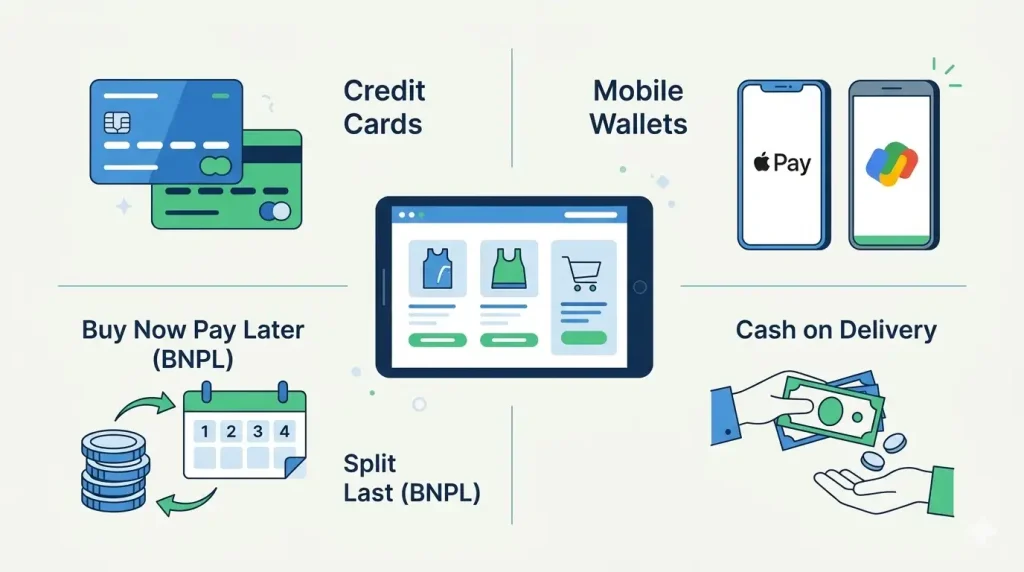
1. Credit and Debit Card Payments (Visa & Mastercard)
Still the most widely used method. However, UAE banks have their own OTP (One-Time Password) authentication flows via SMS or banking apps as part of 3D Secure verification. Your gateway must handle these flows smoothly without causing checkout drop-offs.
2. Apple Pay and Google Pay
Mobile wallet adoption in the UAE is extremely high. Apple Pay, in particular, is widely used among iPhone users, and many Emirati consumers expect it as a default option. A single-tap checkout via Apple Pay can significantly improve conversion rates on mobile.
3. Buy Now, Pay Later (BNPL) — Tabby and Tamara
Tabby and Tamara are the two dominant BNPL providers in the UAE and wider GCC. They allow customers to split payments into 4 interest-free instalments. For ecommerce stores selling products above AED 300–500, offering BNPL visibly at checkout — not just on the product page — can increase average order value (AOV) by 20–40%.
These are not niche options anymore. They are mainstream expectations for checkout, especially among younger UAE shoppers aged 18–35.
4. Cash on Delivery (COD)
Despite the digital boom, COD remains relevant in certain segments of the UAE market, particularly for first-time buyers who haven’t yet built trust with a new brand. It is advisable to offer COD alongside prepaid options, especially if you are in fashion, electronics, or home goods.
5. Bank Transfers and Local Wallets
For B2B ecommerce or higher-ticket items, some customers prefer direct bank transfer. Local digital wallets (such as those offered by UAE banks) are also gaining traction.
Overview of Popular E-Commerce Payment Gateways in the UAE
Not all gateways are built for the UAE market. Here is a breakdown of the most relevant options for e-commerce stores developed on WooCommerce, Shopify, Magento, or custom PHP:

International Gateways
| Gateway | Best For | Strengths | Weaknesses for UAE |
|---|---|---|---|
| PayPal | Cross-border / international customers | Global brand recognition, buyer protection | Limited local payment support, higher fees |
| Stripe | Tech-savvy businesses, startups | Developer-friendly, flexible API | Limited direct UAE bank integrations |
| 2Checkout (Verifone) | International sales | Supports 45+ payment methods | Less optimised for local UX |
UAE-Friendly and Regional Gateways
| Gateway | Best For | Key Feature |
|---|---|---|
| PayTabs | SMEs in UAE/GCC | Local support, Arabic UI, supports AED |
| Network International | Enterprises | Preferred by UAE banks, strong local reach |
| Telr | SMEs and startups | Easy setup, supports 120+ currencies |
| Checkout.com | Enterprise ecommerce | High performance, supports UAE card schemes |
BNPL Providers
| Provider | Split | Best For |
|---|---|---|
| Tabby | 4 payments, 0% interest | Fashion, Electronics, Home |
| Tamara | 3 or 4 payments | Multi-category retail, GCC wide |
Pro tip: For maximum conversion, display Tabby or Tamara instalment amounts directly on product pages, cart pages, and checkout pages — not just in an FAQ.
Our dedicated Payment Gateway Integration covers all of the above gateways, configured specifically for UAE ecommerce workflows.
How to Choose the Right Gateway for Your Dubai E-commerce Website
With so many options, the right choice depends on your business model, your customers, and the platform your store is built on.
Key Selection Criteria
1. Transaction Fees and MDR (Merchant Discount Rate)
Look at both the percentage fee per transaction and any monthly/setup fees. PayTabs and Telr tend to be competitive for UAE SMEs, while Network International is better suited for larger volumes.
2. Supported Currencies and Settlement Time
Ensure the gateway supports AED settlement. Some international gateways settle in USD, requiring an additional currency conversion step that can reduce your margins.
3. Payment Method Coverage
Does the gateway support Visa, Mastercard, Apple Pay, Google Pay, Tabby, and Tamara? A multi-gateway setup (e.g., primary gateway + Tabby for BNPL) is often the best approach.
4. Platform Compatibility
- WooCommerce: PayTabs, Telr, Stripe, and Tabby all have native WooCommerce plugins.
- Shopify: Checkout.com, PayTabs, and Tabby have official Shopify app integrations.
- Magento: Network International and PayTabs offer Magento extensions.
- Custom PHP: Requires direct API integration — ensure the gateway’s API documentation is robust.
Explore our Shopify Development Services in UAE and Magento Website Development Services to understand how we handle gateway integration per platform.
5. UAE Merchant Registration Requirements
Most UAE-based gateways require:
- Valid trade licence
- Emirates ID or passport of the owner
- Bank account in the UAE
- MOA (Memorandum of Association) for LLCs
- Proof of website live and operational
This is important to plan for during the development phase — not after launch.
6. Customer Support and Dispute Resolution
Choose a gateway with UAE-based support, particularly if you plan to handle chargebacks or refund disputes. Local support teams understand UAE consumer protection laws.
Technical Integration Best Practices (WooCommerce, Shopify, Magento, Custom PHP)
Once you have selected your gateway(s), the development and integration phase begins. Here is how it works across the major platforms Prontosys uses for e-commerce website development.
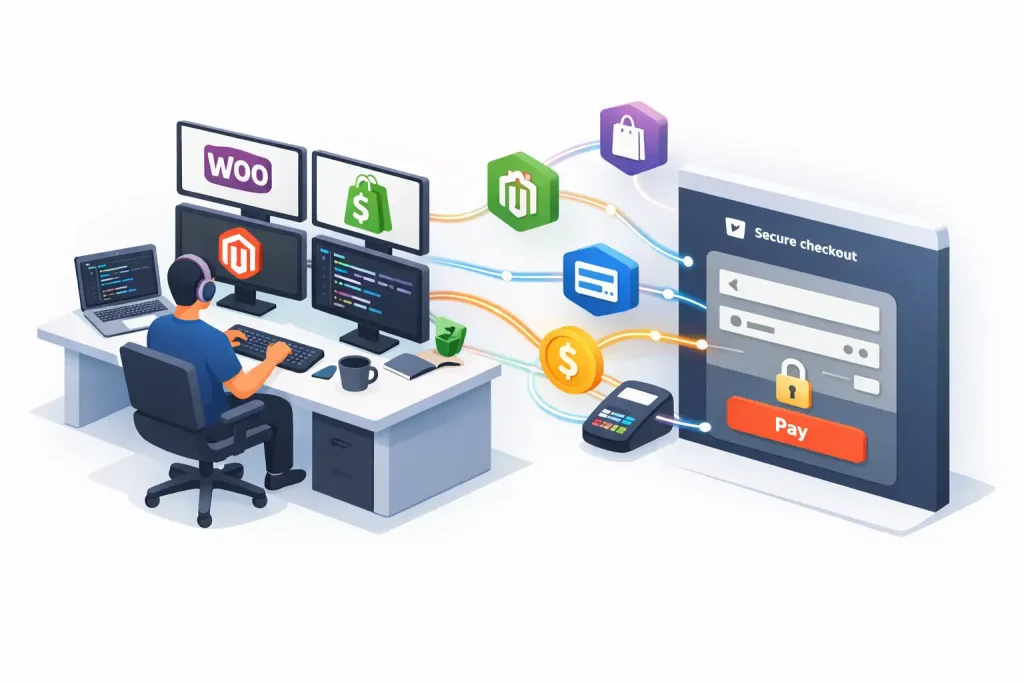
WooCommerce Integration
WooCommerce (WordPress-based) is the most popular platform for SME ecommerce in the UAE. Most UAE-friendly gateways offer native WooCommerce plugins that can be installed, configured, and activated from the WordPress dashboard.
Steps:
- Install the gateway’s official WooCommerce plugin (e.g., PayTabs for WooCommerce)
- Configure API keys, merchant ID, and IPN (Instant Payment Notification) URL
- Set the return URL and notification URL within the gateway’s merchant dashboard
- Enable the payment method in WooCommerce → Settings → Payments
- Test in sandbox mode with the gateway’s test credentials
- Switch to live mode after QA
For Tabby and Tamara on WooCommerce, use their official plugins and ensure you add the instalment widget shortcode to product and cart pages for maximum visibility.
Shopify Integration
Shopify has its own Payment Providers settings, and since Shopify Payments is not available in the UAE, all transactions must route through a third-party gateway.
Steps:
- Go to Shopify Admin → Settings → Payments → Third-party providers
- Select or manually configure your preferred gateway
- For BNPL, use the Tabby or Tamara app from the Shopify App Store
- Handle webhook notifications for order status updates (paid, failed, refunded)
- Test end-to-end in Shopify’s test mode before going live
Refer to our Shopify Development Services for details on how we handle custom Shopify payment configurations.
Magento Integration
Magento (Adobe Commerce) is used for larger, more complex ecommerce stores in the UAE — particularly in retail and manufacturing sectors.
Steps:
- Download and install the gateway’s official Magento extension from Magento Marketplace
- Configure the extension under Stores → Configuration → Sales → Payment Methods
- Map order statuses (pending, processing, complete, cancelled) to gateway callback responses
- Set up cron jobs for transaction status sync
- Test full checkout flow — including refunds and partial captures — in sandbox
Our Magento Website Development Services include full gateway integration, configuration, and QA as part of the development package.
Custom PHP / Headless Ecommerce Integration
For businesses requiring fully custom functionality — or those building multi-vendor ecommerce platforms — direct API integration is the way to go.
Core concepts:
- Use the gateway’s REST API (or SDK) to create and manage payment sessions
- Handle webhooks for asynchronous event updates (payment.succeeded, payment.failed, refund.processed)
- Never store raw card data on your server — use the gateway’s tokenisation to save cards for repeat purchases
- Implement idempotency keys in API calls to prevent duplicate charges
Basic PHP flow:
php// Create a payment session via PayTabs API (example)
$response = $gateway->createPaymentSession([
    'profile_id'     => PROFILE_ID,
    'tran_type'      => 'sale',
    'tran_class'     => 'ecom',
    'cart_id'        => $order->id,
    'cart_amount'    => $order->total,
    'cart_currency'  => 'AED',
    'cart_description' => 'Order #' . $order->id,
    'customer_details' => [...],
    'callback'       => CALLBACK_URL,
    'return'         => RETURN_URL,
]);
For multi-vendor marketplaces, the integration is more complex: you need to handle split payments (distributing funds to individual vendors minus your commission), vendor-specific refunds, and commission tracking. Our Multi-Vendor Ecommerce Website Development team has deep experience building these workflows.
Pre-Launch QA Checklist for Payment Integration
Before going live, run through this checklist:
- Successful payment with Visa test card
- Successful payment with Mastercard test card
- Failed payment (insufficient funds) handled gracefully
- 3D Secure OTP flow tested
- Order status correctly updates after payment
- Refund initiated and processed from admin
- Webhook notifications received and logged
- IPN URL publicly accessible (not behind firewall)
- Apple Pay and Google Pay buttons display on supported browsers
- BNPL widget displays correct instalment amounts
- Currency shown in AED throughout checkout
- SSL certificate active and valid
Optimising Checkout UX for Higher Conversions
Technical integration is only half the equation. The design and UX of your checkout flow directly determines how many customers complete their purchase.
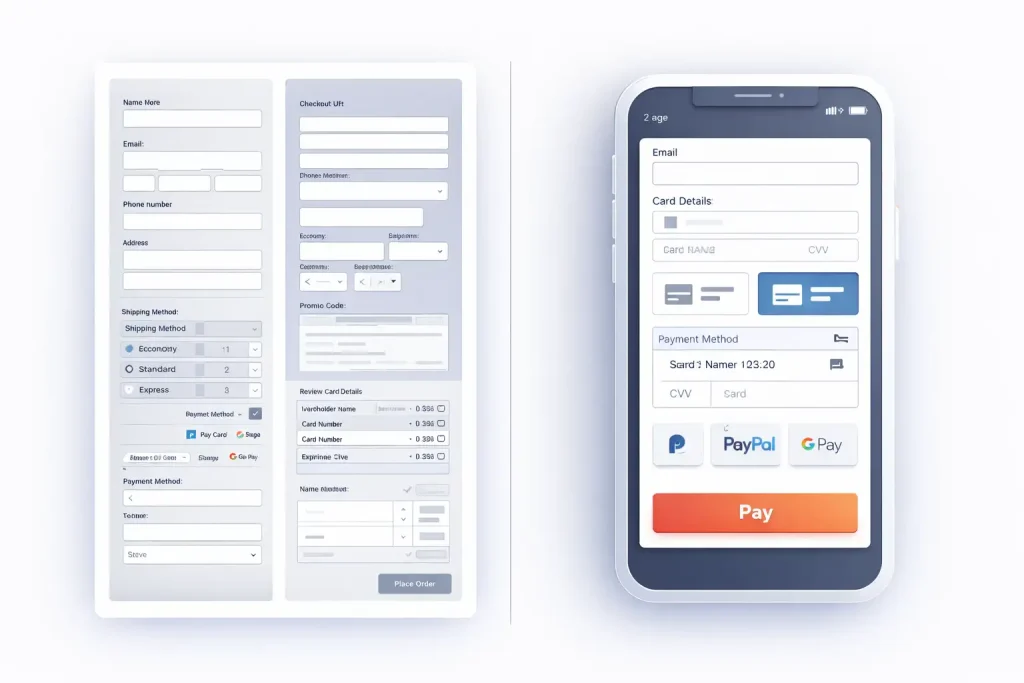
One-Page vs Multi-Step Checkout
- One-page checkout reduces the perceived effort of completing a purchase. All fields (address, payment, review) are visible on a single scroll. Best for stores with a simple product range.
- Multi-step checkout is better for complex orders (e.g., multiple delivery addresses, customisation options). Use a clear progress indicator so customers always know where they are.
For UAE ecommerce, one-page checkout with a strong mobile design is usually the recommended approach. Over 75% of UAE online shopping happens on mobile devices.
Guest Checkout Is Non-Negotiable
Forcing account creation before purchase is a major conversion killer. Always offer guest checkout as the default. You can prompt account creation after the order is confirmed.
UAE-Specific UX Considerations
- Address fields: UAE addresses often do not follow a standard postcode format. Use emirate + area + landmark fields instead of rigid postcode validation.
- Delivery slot selection: UAE shoppers increasingly expect same-day or next-day delivery options at checkout.
- Arabic language support: If you serve Emirati and Arab expat customers, offer an Arabic checkout option. Right-to-left (RTL) layouts require additional development attention.
- WhatsApp order confirmation: Many UAE brands send WhatsApp order confirmations in addition to email. This can be integrated via WhatsApp Business API post-checkout.
BNPL Placement for Maximum Impact
Do not bury Tabby or Tamara in the payment method list. Place their instalment messaging (e.g., “Or pay AED 75 x 4 with Tabby”) in:
- Product pages — near the price
- Cart/basket page — as a highlighted option
- Checkout payment section — as a prominent payment method with logo
Security, Fraud Prevention, and Compliance
The UAE has strict consumer data protection requirements, and your payment integration must be built with security as a first principle.

SSL and HTTPS
All ecommerce websites must operate over HTTPS. Without a valid SSL certificate, most modern browsers will actively warn users against proceeding, and payment gateways will refuse to load on unsecured pages. Ensure your SSL certificate is renewed and monitored.
PCI DSS Compliance
The Payment Card Industry Data Security Standard (PCI DSS) governs how card data must be handled. The simplest way to achieve compliance is to never touch card data yourself — route all card entry through the gateway’s hosted payment page or a JavaScript-based tokenisation widget. This keeps your PCI scope minimal (SAQ A level).
Tokenisation for Repeat Purchases
If your store has a subscription model or repeat customer base, implement card tokenisation — the gateway stores the card details securely and gives you a token to reference in future charges. This is available through PayTabs, Checkout.com, and most enterprise gateways.
3D Secure and UAE Bank OTP
UAE banks enforce 3D Secure on most Visa and Mastercard transactions. Your gateway must handle the 3DS redirect and OTP flow seamlessly. A poor implementation — where the OTP page looks different from your store or times out — will cause customers to abandon the purchase out of confusion or suspicion.
Fraud Rules Configuration
Most gateways (especially PayTabs, Checkout.com, and Stripe) allow you to configure fraud detection rules:
- Flag orders where billing and shipping countries differ significantly
- Hold high-value orders for manual review
- Block repeat failed transaction attempts from the same IP
- Velocity checks for multiple orders in short periods
Configure these rules in the gateway’s merchant portal before going live.
Also Read:- E-commerce Conversion Rate Optimization: Increasing Sales Beyond the 1.82% Average
Post-Launch Monitoring and Optimisation
Your payment integration is not a set-and-forget task. Continuous monitoring is essential for both technical reliability and commercial performance.
Key Metrics to Track
| Metric | What It Tells You |
|---|---|
| Payment Success Rate | % of payment attempts that complete successfully — target 95%+ |
| Cart Abandonment Rate at Checkout | Where in checkout are customers dropping off? |
| Chargeback Rate | High chargebacks signal fraud risk or customer experience issues |
| BNPL Uptake Rate | % of customers choosing Tabby/Tamara — indicates demand for instalment options |
| Average Order Value (AOV) with BNPL vs without | Validates the commercial impact of BNPL integration |
| Mobile vs Desktop Payment Success Rate | Identifies if mobile checkout has specific issues |
Use Google Analytics 4 (GA4) with checkout funnel events, plus your gateway’s merchant dashboard, to monitor these metrics weekly.
A/B Testing Checkout Elements
Once your store is live, run A/B tests on:
- CTA button text: “Pay Now” vs “Complete Order” vs “Place Order”
- Payment method order: Test whether placing Apple Pay or BNPL first increases their uptake
- Trust badges placement: Security icons near the payment section can reduce hesitation
- Instalment messaging copy: “Split into 4 payments” vs “Pay AED X today, rest later”
When to Scale Your Payment Stack
As your business grows, consider adding:
- A secondary payment gateway as a failover (if your primary gateway goes down, orders should not fail)
- Currency localisation if you begin shipping internationally from the UAE
- A subscription billing gateway (e.g., Chargebee or Stripe Billing) if you launch a subscription product
- Recurring payment support for membership or SaaS-style ecommerce
When You Should Consider Switching or Adding a New Gateway
Even if your current gateway works, there may be signs that it is holding your growth back.
Signs Your Gateway Is Limiting Your Business
- Declining payment success rate (below 90%) despite no technical errors on your side — often caused by outdated gateway integrations with UAE banks
- No support for BNPL — if Tabby and Tamara are not available on your platform, you are likely losing a significant share of orders
- High transaction fees eating into margins as your volume grows — renegotiate or switch to a gateway with volume-based pricing
- Poor customer support — if resolving a chargeback or technical issue takes weeks, it affects your operations
- Not supporting newer payment methods like Apple Pay, Google Pay, or local digital wallets
- Customers reporting failed payments on UAE-issued cards — a classic sign of poor local bank compatibility
Migration Considerations
Switching gateways on a live ecommerce store requires careful planning:
- Test the new gateway in staging first — never integrate directly on a live site
- Run both gateways in parallel briefly (new gateway as primary, old as backup) to catch any edge cases
- Migrate saved card tokens — if you have repeat customers with saved cards, work with both gateways to arrange a secure token migration
- Update all webhooks, IPN URLs, and callback URLs to point to the new gateway
- Inform your finance team about the settlement account and timeline changes
Our Payment Gateway Integration Services include full migration support — from planning to go-live — so your revenue is never interrupted.
Conclusion
A well-chosen, correctly integrated, and properly optimised payment gateway is one of the highest-ROI investments you can make in your UAE ecommerce store. It determines whether customers trust your store, complete their purchase, and return again.
The UAE market has its own unique requirements — BNPL with Tabby and Tamara, local bank 3D Secure flows, Apple Pay adoption, AED currency expectations, and Arabic language support. Generic, plug-and-play international gateways often fall short of these expectations.
Whether you are building a new store on Shopify or WooCommerce, scaling an enterprise Magento platform, or developing a custom multi-vendor ecommerce marketplace, the right payment strategy needs to be architected from day one — not retrofitted after launch.
At Prontosys, we combine our expertise in e-commerce website development in Dubai with deep experience in payment gateway integration to deliver checkout experiences that convert. From gateway selection and technical integration to checkout UX optimisation and post-launch monitoring, we handle every aspect of your payment infrastructure.
Ready to build a payment experience your UAE customers will trust and love?
Get a Free Consultation with Prontosys →
Frequently Asked Questions (FAQ)
What is the best payment gateway for ecommerce in Dubai?
For most UAE ecommerce businesses, a combination of PayTabs or Checkout.com (for card payments and Apple Pay) plus Tabby or Tamara (for BNPL) provides the best coverage. The right choice depends on your platform, transaction volume, and target customers.
Is Tabby available for WooCommerce in UAE?
Yes. Tabby has an official WooCommerce plugin that can be installed from the WordPress plugin directory and configured with your Tabby merchant API keys.
What is 3D Secure and do I need it in the UAE?
3D Secure (3DS) is an authentication layer for online card payments. UAE banks require it for most transactions. Your gateway should support 3DS2 — the latest version — for a smoother OTP experience.
How do I reduce cart abandonment at checkout?
Use one-page checkout, offer guest checkout, display BNPL instalment amounts prominently, support Apple Pay for mobile users, and ensure your payment page loads in under 2 seconds.
Can Prontosys integrate multiple payment gateways on one ecommerce website?
Absolutely. We regularly integrate 2–3 gateways on a single store — a primary gateway, a BNPL provider, and a failover gateway — for maximum coverage and reliability.

Vijit Tyagi is the CEO and Founder of ProntoSys, a global digital marketing and IT services agency headquartered in Dubai. A B.Tech graduate in Computer Science from Dr. A.P.J. Abdul Kalam Technical University, he brings over 15 years of industry experience. Under his leadership, ProntoSys has expanded across the UAE, UK, and India, becoming a certified Google Partner with a team of 120+ professionals. Tyagi focuses on client-centric digital solutions, ROI-driven strategies, and helping businesses adopt effective digital transformation. He also contributes thought-leadership articles on digital marketing in major publications, emphasizing innovation and growth for modern businesses.