
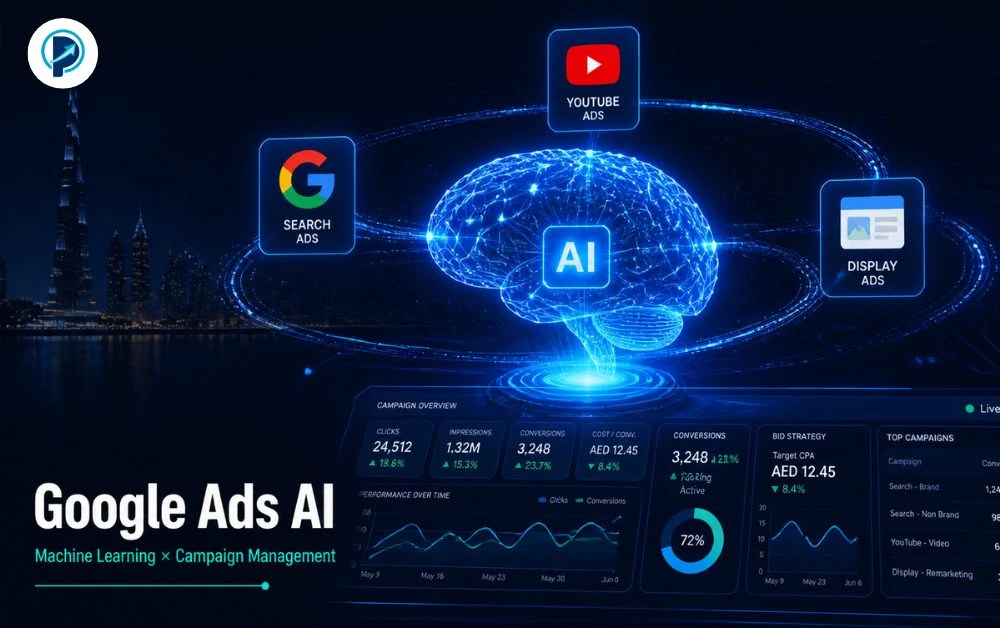
Not long ago, running a successful Google Ads campaign meant manually adjusting bids, writing dozens of ad variations, and obsessing over keyword match types. Today, machine learning does all of that — and more — in milliseconds, at a scale no human team could match. Google Ads AI is no longer a future promise; it is the engine running your campaigns right now.
Whether you are a business owner in Dubai evaluating your ad spend, or a marketing manager trying to get more from your monthly Google Ads budget, understanding how AI and machine learning shape your campaigns is essential. This guide answers every major question about Google Ads AI — from the basics to emerging tech trends — and shows you exactly how to use it to your advantage.
Table of Contents
Table of Contents
What Is AI and Why Does It Matter in Advertising?
Artificial intelligence (AI) refers to computer systems designed to perform tasks that normally require human intelligence — reasoning, learning, problem-solving, and prediction. In advertising, AI does not replace strategy; it amplifies it.
Machine learning (ML) is a core branch of AI in which systems learn from large amounts of data and continuously improve their predictions without being explicitly re-programmed. Inside Google Ads, ML is the technology that powers bid decisions, audience targeting, creative optimization, and campaign automation across Search, Display, YouTube, and beyond.

Who Is the Father of AI?
The term “artificial intelligence” was coined by John McCarthy, a computer scientist who organized the landmark 1956 Dartmouth Conference — widely recognized as the founding event of AI as a formal discipline. McCarthy also developed LISP, one of the earliest and most influential programming languages in AI research. His foundational work laid the groundwork for every AI system operating today, including the machine learning models that power Google Ads Smart Bidding and Performance Max.
Is Machine Learning an Emerging Technology?
Machine learning as a concept has been studied since the 1950s, but its large-scale commercial application in advertising platforms is genuinely new. For most of its history, ML research lived in academic labs. It took the explosion of internet data, affordable cloud computing, and large-scale conversion tracking infrastructure to make ML practical inside ad auction systems.
What is still actively emerging in 2026 is the depth of ML integration:
- ML now sets bids at every single auction, not just at the campaign level
- It interprets the intent behind a search query, not just its exact text
- It allocates budget across channels in real time, replacing manual campaign structures
- It generates and tests ad creative combinations automatically
- Agentic AI — systems that act, monitor, and adjust without human prompting — is becoming a mainstream layer on top of Google Ads itself
So while ML is a mature science, its role in day-to-day campaign management is still rapidly evolving. It is simultaneously established technology and one of the most fast-moving frontiers in digital marketing.
Does Google Ads Use Machine Learning?
Yes — extensively. Machine learning is embedded into nearly every major feature of Google Ads. Here is a breakdown of where ML operates inside the platform:
| Google Ads Feature | How ML Is Used |
|---|---|
| Smart Bidding | Sets the optimal bid per auction using real-time signals (device, location, time, user intent, audience) |
| Performance Max | Allocates budget across all Google channels (Search, YouTube, Display, Discover, Gmail, Maps) to maximize conversions |
| Responsive Search Ads (RSAs) | Tests thousands of headline and description combinations and assembles the best ad for each query and user |
| Broad Match Keywords | Interprets the intent behind a query, not just its literal text, to match relevant searches |
| Smart Campaigns | Automates targeting, bidding, and creative decisions for smaller advertisers |
| Audience Segments | Predicts which users are “in-market” for products and services based on behavioural signals |
| Ad Strength & Recommendations | Uses ML to evaluate creative quality and suggest improvements |
| Conversion Prediction | Estimates the likelihood of a conversion before setting a bid, using hundreds of real-time signals |
For UAE businesses competing in high-CPC markets like real estate, healthcare, and finance in Dubai, this level of ML-driven optimization is not optional — it is what separates profitable campaigns from wasted ad spend. You can learn more about how ProntoSys structures AI-powered campaigns in our Performance Max (PMax) Campaigns Guide for UAE.
What Are the Emerging Trends in AI and Machine Learning?
The AI landscape in digital advertising is shifting fast. Here are the most significant trends marketers and business owners need to understand in 2026:
1. Hyper-Personalization at Scale
AI can now tailor ad creatives, landing page content, and offers to individual users based on real-time behavioural and contextual signals. What used to require custom audience segments and manual creative production now happens automatically, driven by ML models that learn which message resonates with which user at which moment.
2. Predictive Audience Targeting
Rather than targeting audiences based on who they are, AI now targets based on what they are about to do. Predictive models score users on conversion likelihood before they even search — enabling advertisers to reach buyers earlier in their decision-making journey.
3. Agentic AI and Autonomous Campaign Management
Agentic AI refers to systems that can take independent actions — not just recommendations — within your Google Ads account. These systems monitor performance, detect anomalies, shift budgets, test creatives, and apply optimizations without waiting for a human to log in. While still early-stage for most platforms, agentic AI is rapidly moving from research to real-world deployment.
4. Generative Engine Optimization (GEO)
As AI-powered answer engines (like Google’s AI Overviews and ChatGPT Search) capture more search traffic, a new discipline called GEO is emerging alongside traditional SEO. GEO focuses on making your content and ad copy machine-readable and authority-signalling so it appears in AI-generated answers, not just traditional search results.
5. Privacy-First AI and First-Party Data Signals
With third-party cookies declining and tracking restrictions tightening globally, AI models are increasingly being trained on first-party data — data a business collects directly from its own customers. Google’s Enhanced Conversions, Customer Match, and offline conversion import features are all part of this shift, giving AI better signals while respecting user privacy.
6. AI-Driven Creative Generation
Generative AI tools — including those being integrated directly into Google Ads — can now draft ad copy, generate image variations, and even produce short video assets. Human oversight remains essential, but AI dramatically accelerates creative production and testing.
7. Real-Time Fraud Detection and Traffic Quality
ML models now analyse traffic patterns in real time to identify and filter invalid clicks, bot traffic, and fraudulent activity — protecting ad budgets automatically.
Work With a Certified Google Ads AI Expert in Dubai
AI-powered Google Ads campaigns offer extraordinary capability — but their performance depends entirely on the quality of the strategy, structure, and data behind them. The algorithm needs the right goals, the right signals, and the right creative inputs to deliver results.
At ProntoSys, UAE Google Certified Ads Agency, our team builds and manages AI-ready Google Ads campaigns for businesses across the UAE — combining expert campaign architecture with the full power of Google’s machine learning tools. From Performance Max to Smart Bidding to first-party data strategy, we handle every layer so your AI is always optimizing for outcomes that matter to your business.
Explore more about why hiring a PPC agency in Dubai gives you an advantage, or compare the top advertising agencies in Dubai to see how ProntoSys stacks up.
Ready to let AI work harder for your Google Ads budget? Get a free Google Ads audit from ProntoSys today.

Vijit Tyagi is the CEO and Founder of ProntoSys, a global digital marketing and IT services agency headquartered in Dubai. A B.Tech graduate in Computer Science from Dr. A.P.J. Abdul Kalam Technical University, he brings over 15 years of industry experience. Under his leadership, ProntoSys has expanded across the UAE, UK, and India, becoming a certified Google Partner with a team of 120+ professionals. Tyagi focuses on client-centric digital solutions, ROI-driven strategies, and helping businesses adopt effective digital transformation. He also contributes thought-leadership articles on digital marketing in major publications, emphasizing innovation and growth for modern businesses.

