

Imagine a potential customer sitting in traffic on Sheikh Zayed Road, asking their phone: “Hey Google, which is the best SEO agency near me in Dubai?” — and your competitor’s page answers that question out loud before they even open a browser tab. This is the reality of voice search in the UAE in 2026, and businesses that are not optimized for it are already losing leads to those who are.
Over 50% of online searches in the UAE are now conducted via voice — one of the highest adoption rates in the world. With smartphone penetration exceeding 99% across the country, and millions of UAE residents relying on Google Assistant, Siri, and Alexa for hands-free queries every single day, voice search has shifted from an emerging trend to a core SEO priority.
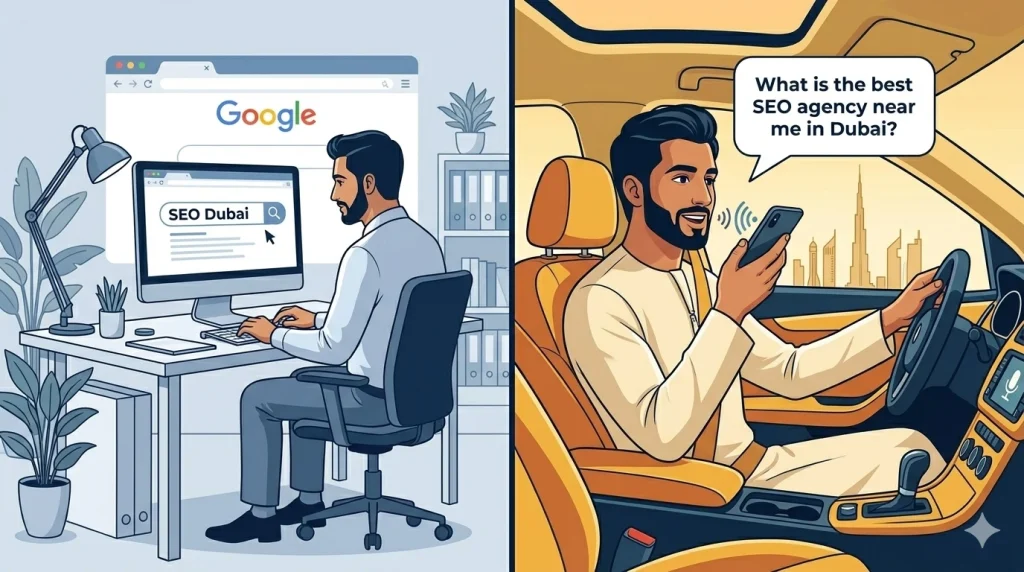
The key difference businesses must understand is this: voice queries are longer, conversational, locally focused, and question-driven. A user typing a search might write “SEO company Dubai” — but the same person speaking to their phone asks “What is the best SEO company for small businesses in Dubai?” These are fundamentally different signals, and they require a fundamentally different optimization approach.
This guide will walk you through exactly what UAE businesses need to do in 2026 to rank for spoken queries — covering technical foundations, content strategies, local SEO, Arabic optimization, and schema markup, with actionable steps you can apply to any business in Dubai, Abu Dhabi, Sharjah, or anywhere across the Emirates.
Table of Contents
Table of Contents
Businesses in Dubai that want to stay competitive need a comprehensive strategy — including voice search — which is why working with a results-driven SEO marketing agency in Dubai makes all the difference.
Why Voice Search Is Booming in the UAE in 2026
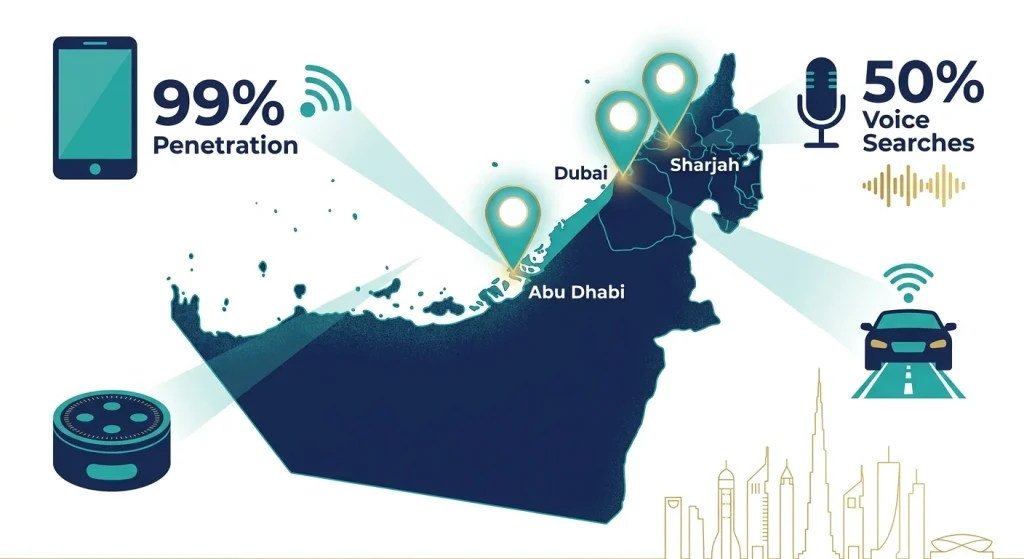
The UAE is not just keeping up with global voice search trends — it is leading them. Several factors make the UAE one of the most voice-search-forward markets in the world:
- Smartphone penetration at 99%+: Virtually every internet user in the UAE owns a smartphone, and voice assistants are built into every device by default.
- 50% of UAE internet users search by voice: This is well above the global average and continues to grow year on year as AI assistants become smarter and more accurate in both English and Arabic.
- Smart home and in-vehicle adoption: Premium smart home devices and connected car systems are widespread in the UAE’s high-income population, creating new voice search environments beyond just mobile.
- Young, tech-forward demographics: Millennials account for 34% of weekly voice assistant users globally, and the UAE has one of the youngest and most digitally active populations in the Middle East.
- Bilingual search behavior: UAE residents query in both English and Arabic, creating a unique dual-language optimization challenge that does not exist in most other markets.
- Global market growth: The voice search market is projected to grow from USD 23.84 billion in 2026 to USD 176.91 billion by 2035, at a CAGR of 24.94% — making now the right time to invest in this channel.Key insight: Voice search results are almost exclusively pulled from pages that are already ranking in the top 3 organic results. This means your traditional SEO foundation directly determines your voice search visibility — they are not separate strategies, they are the same strategy executed at a higher level.
Related read:- Top Secret to SEO Growth: How to Identify and Fill Keyword Gaps Like a Pro?
How Voice Search Differs from Traditional Text Search
Understanding the fundamental difference between how people type and how they speak is the first step to optimizing for voice queries. Here is a direct comparison:
| Factor | Text Search | Voice Search |
|---|---|---|
| Query length | Short (2–3 words) | Long (6–10 words) |
| Tone | Keyword-based | Conversational / Question-based |
| Intent | Broad | Specific / Local / Action-driven |
| Device | Desktop / Mobile | Mobile / Smart speaker / In-car |
| Language in UAE | Mostly English | English + Arabic |
| Result format | Multiple blue links | Single spoken answer |
| User context | Sitting at desk | Hands-free / On the move |
This table reveals why standard keyword strategies fall short for voice. When a user speaks, they are often in motion — commuting, cooking, driving — which means their queries carry stronger local intent (“near me”, “open now”, “best in Dubai”) and they expect immediate, accurate answers, not a list of ten links to scroll through.
To understand the foundation that makes voice search work, read our guide on On-Page SEO and how content structure signals relevance to Google.
The SEO Foundation You Need Before Optimizing for Voice Search
Before applying any voice-specific tactics, your website must have a strong technical and on-page SEO foundation. Voice assistants pull answers almost exclusively from pages that are already ranking in positions 1–3 on Google. Without that underlying authority, no amount of voice optimization will produce results.
Here are the non-negotiable foundations:
1. Page Speed
Voice search results load on average 52% faster than typical web pages. If your site is slow, Google will not use it as a voice answer, regardless of content quality. Aim for a fully loaded mobile page in under 3 seconds.
2. Mobile-First Design
The overwhelming majority of voice queries come from mobile devices. Your site must be fully responsive, with no horizontal scrolling, readable font sizes, and tap-friendly buttons.
3. HTTPS / Security
Nearly all voice search results come from HTTPS-secured pages. If your site is still on HTTP, this is the first fix you need to make.
4. Domain Authority and E-E-A-T
Google’s voice answers prioritize pages from sites it trusts. Building consistent backlinks, having author bios, citing sources, and demonstrating expertise, authoritativeness, and trustworthiness (E-E-A-T) across your site directly impacts your ability to win voice answers.
5. Structured Content
Pages with clear heading hierarchies (H1 → H2 → H3), short paragraphs, bullet points, and FAQs are far more likely to be selected as voice answers than dense, unstructured content.
Not sure if your website’s technical foundation is voice-ready? Our Technical SEO guide walks you through every critical element to fix.
7 Proven Strategies to Optimize for Voice Search in the UAE
1. Target Conversational, Long-Tail Keywords
Voice users speak in full natural sentences. Instead of targeting “SEO agency Dubai”, you need content that answers “What is the best SEO agency for small businesses in Dubai?” or “How do I improve my website ranking in the UAE?”
How to find voice-friendly keywords:
- Use Google’s “People Also Ask” boxes — these are literally the questions users are asking
- Mine Answer the Public and AlsoAsked.com for question patterns in your niche
- Review your Google Search Console queries for long-tail phrases already getting impressions
- Build a keyword list organized around: Who, What, When, Where, Why, How question formats
- Think about what your Dubai customers ask during sales calls — then make those questions into blog headings
Pro tip: In the UAE, common voice query starters include: “What is the best…”, “How do I find…”, “Where can I get…”, “Is there a…near me”, and “Tell me about…” — structure your H2s and H3s around these patterns.
2. Optimize for Featured Snippets (Position Zero)
Featured snippets — the boxed answers at the top of Google search results — are the primary source of voice search answers. When Google reads a voice answer aloud, it is almost always reading from a featured snippet.
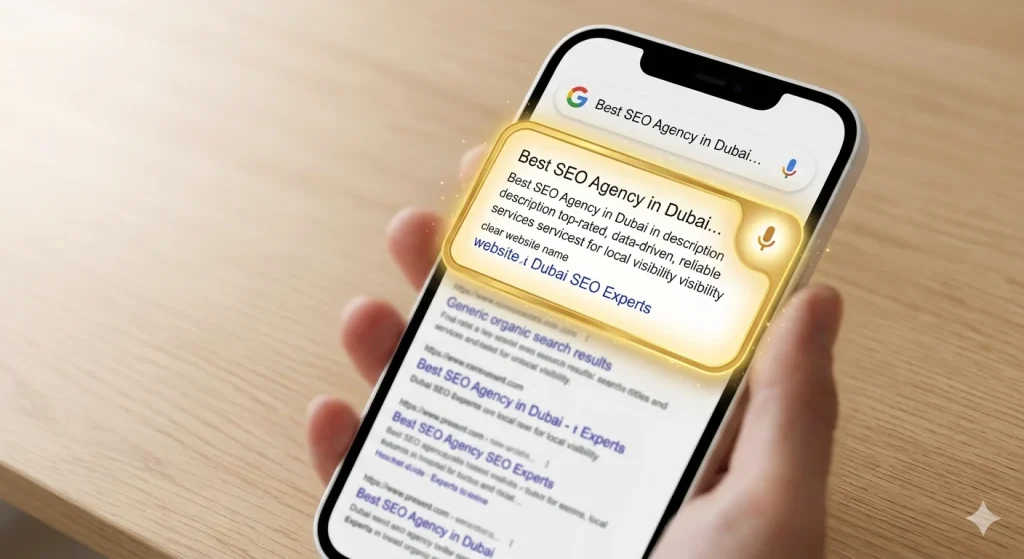
How to win featured snippets:
- Write a direct answer immediately after the question heading. The ideal snippet answer is 40–60 words — a tight, informative paragraph that directly addresses the question without preamble.
- Use structured formats. Numbered lists, bullet points, and comparison tables are frequently pulled as snippets for how-to, list, and comparison queries.
- Keep the question in the H2 or H3 exactly as users phrase it. Google matches heading text to user queries when selecting snippets.
- Target low-to-medium competition queries first. It is easier to win a snippet for a specific niche question like “How does local SEO work for Dubai restaurants?” than for broad queries like “What is SEO?”
The formula: Question as H2/H3 → 40–60 word direct answer paragraph → supporting bullet points or numbered list.
3. Implement FAQ Schema Markup
FAQ schema is one of the most powerful tools for voice search optimization. When you mark up your FAQ content using FAQPage structured data, you are explicitly telling Google: “This is a question and this is its answer — please use this for search results.”
Best practices for FAQ schema in UAE:
- Keep each answer to 2–3 sentences. The first sentence acts as the “soundbite” that voice assistants read aloud.
- Use natural language. Answers should sound good when spoken, not like technical documentation.
- Add FAQs to your key service pages and blog posts — not just standalone FAQ pages.
- Use HowTo schema for any process-based content (e.g., “How to set up Google Business Profile in Dubai”).
- Validate using Google’s Rich Results Test after implementation to confirm the schema is correctly read.
For a deeper look at how structured data fits into your overall strategy, explore our guide on 15 Most Powerful SEO Tips including schema markup and technical fixes.
4. Optimize Your Google Business Profile for Voice Queries
The majority of voice searches have local intent. When someone says “Find me an SEO agency near me” or “Best digital marketing company in Dubai“, Google cross-references your Google Business Profile (GBP) to determine which local businesses to surface.
Google Business Profile optimization for voice search:
- Complete every field: business name, address, phone number, website, hours, categories, and service descriptions — in both English and Arabic.
- Choose the most specific primary category available for your business type.
- Write a keyword-rich, bilingual description that naturally includes phrases like “SEO agency in Dubai” and their Arabic equivalents.
- Add photos regularly — GBP listings with frequent photo updates see higher engagement signals, which influence local voice results.
- Accumulate and respond to reviews: Review volume and recency are major local ranking factors, and Google often cites businesses with strong reviews in voice responses.
- Use Posts in GBP to signal that your business is active and regularly updated.
5. Build a Mobile-First, Fast-Loading Website
Since most voice queries come from mobile devices, Google evaluates your mobile experience first when deciding whether to pull your content as a voice answer.
Technical checklist for mobile voice readiness:
- Core Web Vitals: Largest Contentful Paint (LCP) under 2.5 seconds, Cumulative Layout Shift (CLS) under 0.1, Interaction to Next Paint (INP) under 200 milliseconds.
- Image compression: Use WebP format for all images, compress files without quality loss using tools like ShortPixel or Squoosh.
- Hosting location: Use a hosting server with a UAE or GCC region data center, or a CDN with Middle East edge nodes, to minimize latency for local users.
- Browser caching and minification: Enable browser caching for static assets and minify CSS, JS, and HTML files to reduce page weight.
- No intrusive interstitials: Pop-ups that cover content on mobile are a ranking penalty and create poor user experience for voice-driven visitors.
Also read:- The Complete Guide to Fixing Core Web Vitals Issues
6. Optimize for Arabic Voice Search
This is perhaps the most overlooked — and most powerful — voice search opportunity for UAE businesses. A significant portion of UAE residents speak Arabic as their primary language and query in Arabic via voice.
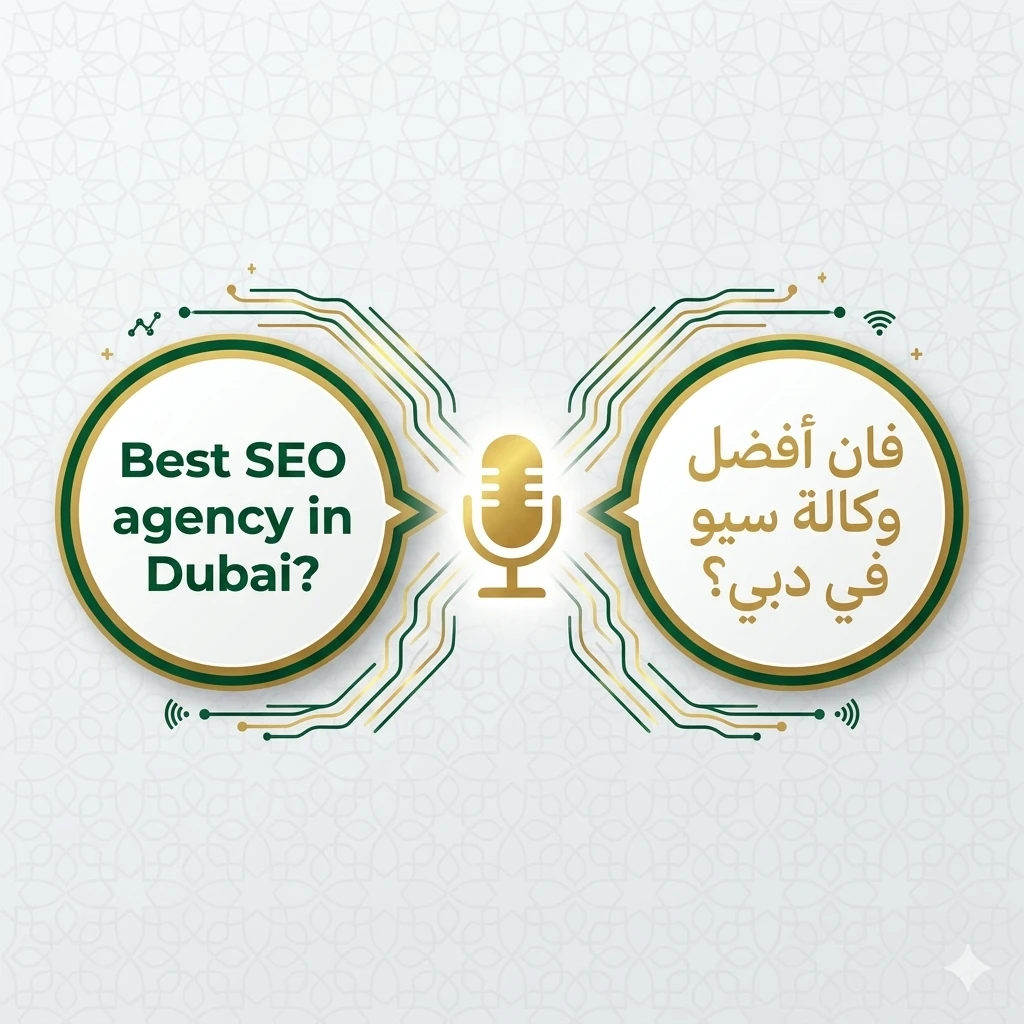
Arabic voice search optimization strategies:
- Create bilingual FAQ sections: Include the same Q&A content in both English and Arabic on key pages, particularly service pages and location pages.
- Arabic GBP optimization: Ensure your Google Business Profile description, posts, and Q&A responses are available in Arabic.
- Arabic NAP consistency: Your business name, address, and phone number in Arabic script must be consistent across all UAE local directories (Yellow Pages UAE, Dubizzle, etc.).
- Use hreflang tags correctly: If you have separate Arabic pages or an Arabic subdomain, implement hreflang (
arandar-AE) to help Google serve the right language version to voice queries. - Think about Emirati dialect: Arabic voice queries in the UAE often use Gulf Arabic expressions rather than Modern Standard Arabic — consider natural dialect phrases in your FAQ content for highly local queries.
7. Use Conversational Content Structure Throughout the Site
Voice search does not just affect your FAQ sections — it should influence how you write every page on your site. Content that sounds natural when read aloud performs better in both traditional SEO and voice search.
Conversational content writing guidelines:
- Write for a human listener, not a reader. Read your content aloud after writing it — if it sounds stiff or jargon-heavy, rewrite it.
- Use short sentences and short paragraphs — maximum 3–4 sentences per paragraph.
- Lead every section with a direct question as the heading, then answer it immediately below.
- Avoid passive voice — active voice sounds more natural when spoken aloud and is generally preferred by Google.
- Use transition phrases like “Here’s what you need to know”, “The short answer is”, or “Let’s break this down” — these signal to Google that a conversational answer follows.
- Match vocabulary to your audience — in the UAE’s multi-cultural business environment, simple, globally understood English performs better for voice queries than highly localized slang or overly technical jargon.
Also read:- Explore 20 Arabic Guest Post Sites for Effective Link Building in the UAE
Voice Search SEO Timeline: When Can UAE Businesses Expect Results?
Voice search optimization is not instant, but certain tactics produce results significantly faster than traditional SEO. Here is a realistic timeline:
| Optimization Type | Expected Timeline |
|---|---|
| Technical fixes (schema markup, page speed, GBP) | 6–10 weeks |
| Featured snippet capture (low/medium competition queries) | 4–6 weeks |
| Competitive local voice queries (Dubai service sectors) | 4–6 months |
| Arabic voice search authority building | 3–5 months |
| Full voice + local SEO ecosystem (all tactics combined) | 6–9 months |
The fastest wins come from implementing FAQ schema on existing pages and fully completing your Google Business Profile. These two actions alone can produce measurable improvements within 4–8 weeks for queries where you are already ranking in positions 4–10.
Voice Search vs. Traditional SEO vs. AEO: What Is the Difference?
As search evolves in 2026, it is important to understand where voice search sits in the broader landscape:
- Traditional SEO focuses on ranking your page in Google’s blue link results — the list of 10 links on a search results page. Success is measured by clicks, impressions, and ranking positions.
- Voice Search SEO focuses on winning the single spoken answer — being the one result read aloud by Google Assistant, Siri, or Alexa. Success is measured by zero-click visibility and direct brand awareness.
- AEO (Answer Engine Optimization) is the emerging discipline of optimizing for AI-powered search engines like ChatGPT, Gemini, and Perplexity, which generate conversational answers rather than returning link lists. AEO builds on voice search principles but extends to AI inference and citation.
Related read:- AEO in Relation to SEO: What They Stand For, Key Differences, and Where Each Strategy Wins
All three are increasingly interconnected in 2026. A page optimized for voice search — with FAQs, structured data, conversational content, and strong authority signals — is also well-positioned for AEO. Want to go beyond voice search and rank in AI-powered engines too? Learn how AI SEO tools are reshaping the search landscape for Dubai businesses.
Voice Search Checklist for UAE Businesses (Quick Audit)
Use this checklist to evaluate your current voice search readiness:
- ✅ Website loads in under 3 seconds on mobile
- ✅ Google Business Profile fully complete in English and Arabic
- ✅ FAQPage schema implemented on key landing pages and blog posts
- ✅ Content headings phrased as user questions (H2/H3 format)
- ✅ Featured snippet candidates identified and optimized with 40–60 word direct answer paragraphs
- ✅ Local citation consistency (NAP) across UAE and Gulf directories
- ✅ Core Web Vitals passing: LCP under 2.5s, CLS under 0.1, INP under 200ms
- ✅ Bilingual FAQ content (Arabic + English) on service and location pages
- ✅ Speakable schema implemented on news or content pages for audio-ready content
- ✅ Long-tail, conversational keywords included in H2/H3 headings and opening paragraphs
- ✅ Google Business Profile reviews responded to within 48 hours
- ✅ Site secured with HTTPS
FAQ: Voice Search SEO in the UAE
What is voice search SEO?
Voice search SEO is the process of optimizing your website, content, and local listings so that voice assistants like Google Assistant, Siri, and Alexa return your page as the spoken answer when a user asks a voice query. It involves a combination of technical SEO, conversational content, FAQ schema, and local optimization.
Why is voice search important for UAE businesses?
Over 50% of online searches in the UAE are conducted via voice — significantly higher than the global average. With near-universal smartphone adoption and heavy smart device usage in UAE households and vehicles, businesses that are not visible in voice search are missing a growing share of high-intent local queries from potential customers in Dubai, Abu Dhabi, and Sharjah.
How do I rank for voice search in Dubai?
To rank for voice search in Dubai, focus on five key areas: winning featured snippets by writing concise 40–60 word answers to common questions, implementing FAQPage schema on your key pages, fully optimizing your Google Business Profile in English and Arabic, ensuring your website passes Core Web Vitals, and building conversational long-tail keyword content that mirrors how your customers actually speak.
How long does voice search optimization take?
Technical fixes like schema markup and GBP optimization typically show results within 6–10 weeks. Winning competitive voice answers for Dubai service sector queries usually takes 4–6 months. Building strong Arabic voice search authority alongside English SEO typically takes 3–5 months with consistent effort.
Does Arabic content help with voice search in the UAE?
Absolutely. A large segment of UAE users query in Arabic via voice. Including bilingual FAQ content in both English and Arabic on your service pages, optimizing your Google Business Profile in Arabic, and maintaining consistent Arabic NAP across UAE directories significantly improves your visibility for Arabic voice queries and local “near me” searches.
What is the difference between voice search SEO and AEO?
Voice search SEO optimizes for spoken answers returned by assistants like Google Assistant and Siri. AEO (Answer Engine Optimization) extends this to AI-generated answers from engines like ChatGPT, Gemini, and Perplexity. Both rely on the same core principles — authoritative content, structured data, and conversational formatting — but AEO also focuses on being cited in AI training and response generation.
Conclusion
Voice search is no longer a future prediction — it is the present reality for businesses competing in the UAE’s digital marketplace. With more than half of online searches in the UAE already conducted via voice, and that share growing as smart devices become more deeply embedded in daily life, optimizing for spoken queries in 2026 is not optional. It is essential.
The good news is that voice search optimization is not a completely separate discipline from what you are already doing. It builds on the same foundation as great technical SEO, quality on-page content, local SEO, and authority building. By adding conversational structure, FAQ schema, Google Business Profile optimization, bilingual Arabic content, and featured snippet targeting on top of that foundation, you create a compounding advantage that drives both traditional rankings and voice search visibility simultaneously.
Start with the quick-win tactics — FAQ schema, GBP completion, and featured snippet optimization — and build from there into a comprehensive, bilingual, voice-ready SEO strategy that positions your business to be found however, wherever, and in whatever language your customers are searching.
Not sure where to start with voice search and overall SEO? Our team at ProntoSys builds custom, result-driven SEO strategies for UAE businesses. Explore how our SEO company in Dubai can help you rank for voice, local, and AI-driven search in 2026.

Vijit Tyagi is the CEO and Founder of ProntoSys, a global digital marketing and IT services agency headquartered in Dubai. A B.Tech graduate in Computer Science from Dr. A.P.J. Abdul Kalam Technical University, he brings over 15 years of industry experience. Under his leadership, ProntoSys has expanded across the UAE, UK, and India, becoming a certified Google Partner with a team of 120+ professionals. Tyagi focuses on client-centric digital solutions, ROI-driven strategies, and helping businesses adopt effective digital transformation. He also contributes thought-leadership articles on digital marketing in major publications, emphasizing innovation and growth for modern businesses.