
Building a website in Dubai is not a one-time event — it is an ongoing journey. From the moment you brief your agency to the day you start monitoring traffic, every phase of the website development lifecycle plays a critical role in how your site performs, ranks, and converts.
Dubai is one of the most competitive digital markets in the world. Businesses in sectors like real estate, retail, healthcare, and professional services are all fighting for the same Google real estate. A poorly planned or poorly maintained website simply will not survive.
This guide walks you through every stage of the web development process — what happens, what to expect, and what questions to ask your agency — so you go into your next project fully prepared.
Table of Contents
Table of Contents
Stage 1 – Discovery & Strategy: Defining What Your Website Needs to Do
Every high-performing website begins long before a single line of code is written. The discovery and strategy stage is where you define your business goals, your target audience, and the competitive landscape in Dubai.
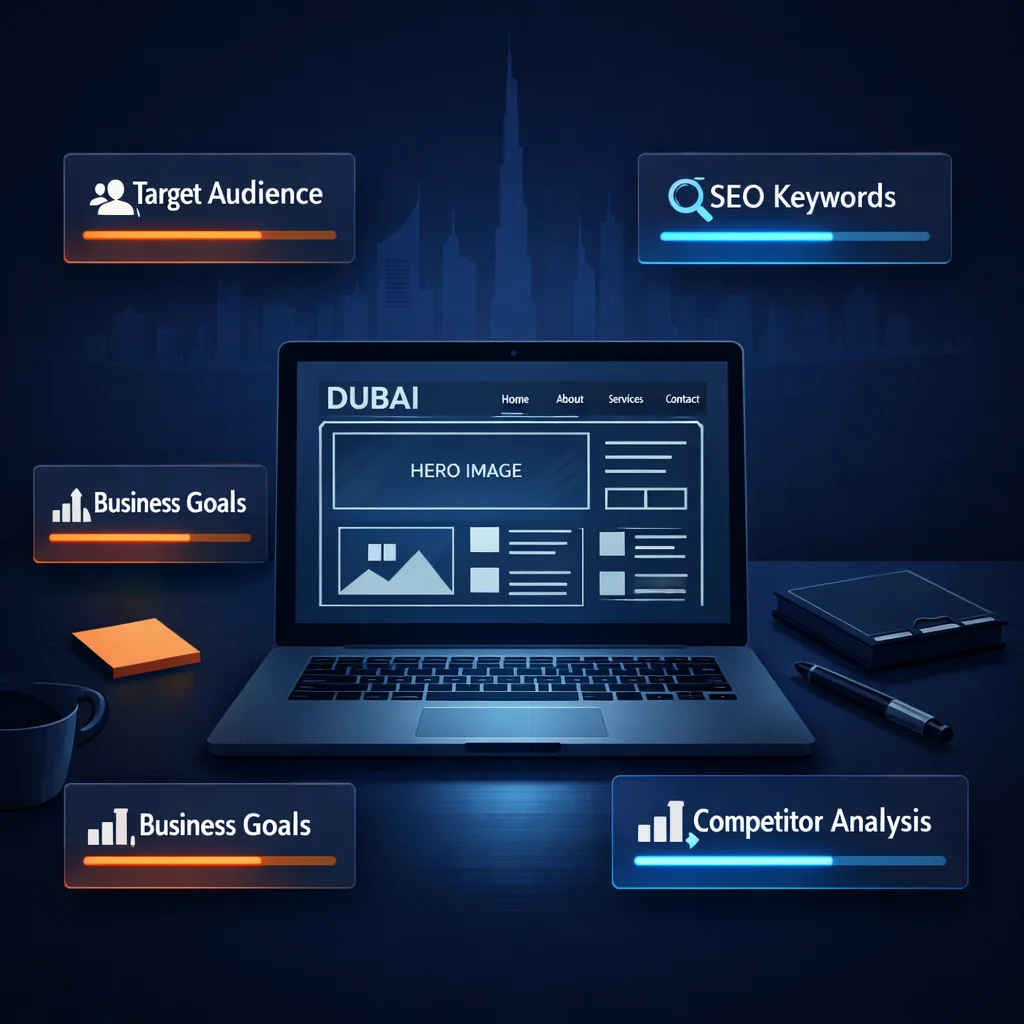
Here is what a proper discovery phase covers:
- Business goals: Are you generating leads, selling products, booking appointments, or building brand credibility?
- Target audience research: Who are your customers in Dubai? What devices do they use? Do they search in English or Arabic?
- Competitor analysis: What are competing Dubai businesses doing well — and where are the gaps you can exploit?
- Technical requirements: Do you need a CMS, an eCommerce store, a booking system, or payment gateway integrations (including UAE-specific options like Telr, Checkout.com, or PayTabs)?
- SEO keyword strategy: Your site architecture should be built around the keywords your customers are searching in Google UAE, not keywords you assume they use.
Skipping this stage is the number one reason websites underperform. Businesses that rush into design without a clear strategy end up rebuilding their websites within two to three years.
Still weighing up whether to build in-house or hire a professional agency? Our guide on why Dubai businesses need a professional web development agency in 2026 covers every reason in detail.
Stage 2: Planning and Sitemap — Building the Right Structure
Once strategy is confirmed, the next step is planning the actual structure of the website. This is where your web development team creates a sitemap — the complete blueprint of every page your site will include, how those pages relate to each other, and how users will move through the site.
A strong sitemap serves two purposes simultaneously: it gives your visitors a logical, intuitive path through your content, and it gives Google a clear picture of what your website covers and which pages are most important.
For Dubai businesses, effective sitemap planning typically includes:
- Individual service pages for each offering — not one generic “Services” page that buries your keywords and confuses users.
- Location pages if your business serves multiple areas across the UAE — Dubai, Abu Dhabi, Sharjah, Ajman, Ras Al Khaimah — each with locally optimized content.
- Multilingual structure for English and Arabic versions, including correct hreflang tagging and RTL layout support for Arabic pages.
- Blog and resource section with a content calendar targeting long-tail keywords your customers search at different stages of their buying journey.
- Internal linking plan — mapping which pages should pass authority to which, and how content naturally funnels users toward your key conversion points.
A flat, well-organized sitemap leads to faster Google indexation, improved crawlability, and better long-term rankings. A bloated or illogical structure does the opposite — it confuses bots and frustrates users in equal measure.
Our website development packages in Dubai are scoped around this planning stage, giving you a structured, scalable page architecture from the very beginning of your project.
Stage 3: UX Design and Wireframing — Designing for Real Dubai Users
Design is far more than aesthetics. Before any visual work begins, your agency should create wireframes — skeletal, content-first layouts that map out every page in structural terms. Wireframes answer the question of where things go before addressing how they look.
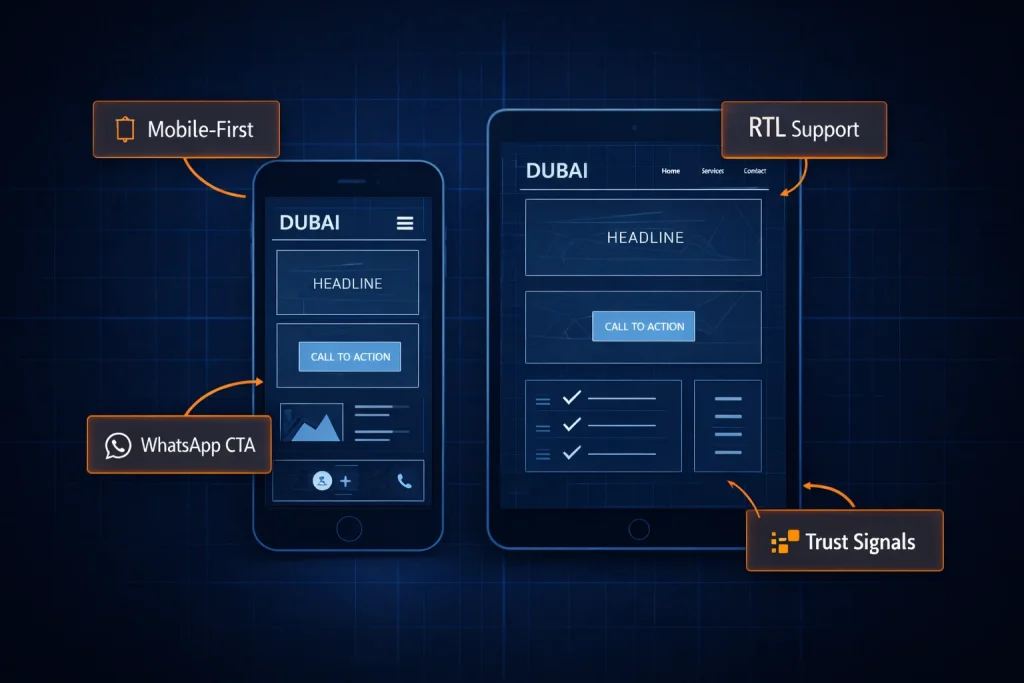
For Dubai businesses, several user experience factors are non-negotiable:
Mobile-first design: Over 95% of UAE internet users access websites via smartphone. Your UX must be designed for the thumb first and the desktop second. Menus, buttons, forms, and CTAs all need to work flawlessly on a 6-inch screen before they are considered for larger viewports.
Right-to-left (RTL) layout support: If your website needs an Arabic version — and for most Dubai businesses it should — every design element must be tested and adjusted for RTL reading direction. This includes navigation, icons, form fields, and image placement.
Trust signals: Dubai customers respond strongly to social proof. Google partner badges, industry certifications, client logos, case studies with real numbers, and verified Google reviews should be woven into your layout early — not bolted on as an afterthought.
WhatsApp CTA placement: In the UAE, WhatsApp is often the fastest path from website visitor to paying customer. Your design should make it effortless for any visitor to open a conversation with one tap, whether on mobile or desktop.
Once wireframes are approved, the design team layers in visual identity — brand colors, typography, photography, icons, and micro-interactions — to produce high-fidelity mockups. A professional agency will provide at least two to three revision rounds before any design is signed off and passed to development.
Our custom website design and development team in Dubai delivers mobile-first mockups with full revision rounds, ensuring the design is conversion-focused before a single page is built.
Stage 4: Development and Integration — Where the Website Gets Built
This is the technical core of the project. Your approved designs are turned into a fully functional, live-ready website using the technology stack that best fits your requirements.
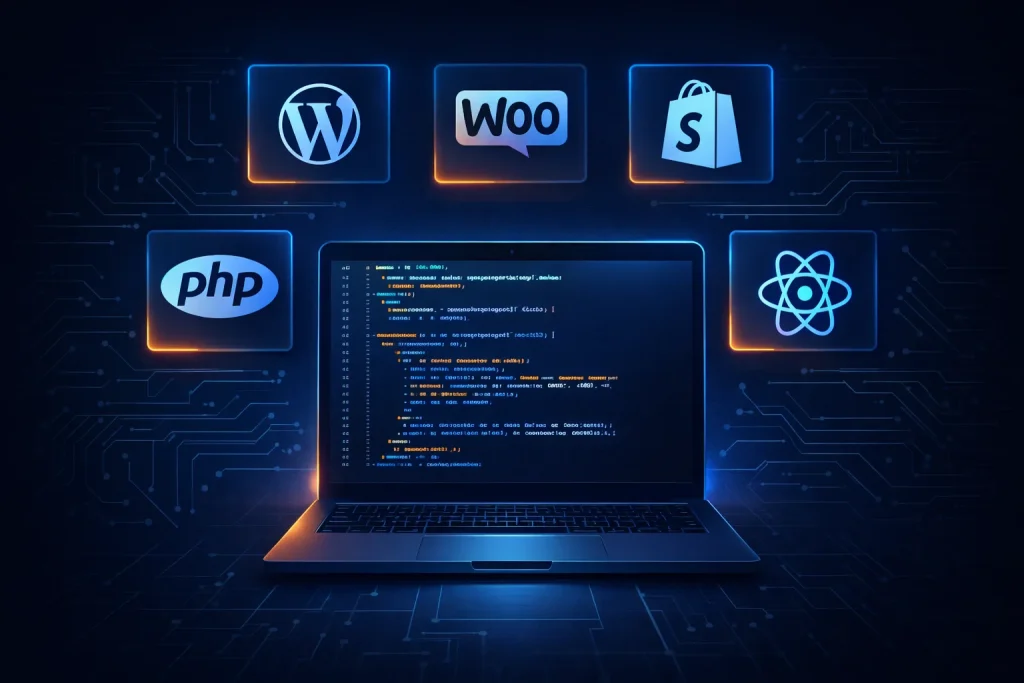
Choosing the right technology for your Dubai business:
- WordPress — The go-to choice for most Dubai business websites, service companies, and blogs. Flexible, SEO-friendly, and easy to manage after handover.
- WooCommerce — The leading eCommerce extension for WordPress, ideal for mid-range product stores that want full content control alongside their catalog.
- Shopify — Better suited for pure eCommerce businesses that prioritize a streamlined management experience over design flexibility.
- PHP / Custom Development — For businesses that need complex logic, custom client portals, or advanced integrations that no CMS can handle out of the box.
- React / Angular — For fast, dynamic front-end experiences used in web applications, property portals, booking platforms, and interactive dashboards.
Performance standards your agency should hit during development:
- Google PageSpeed score of 90+ on both mobile and desktop — this directly affects your Google rankings, your bounce rate, and the number of visitors who actually stay on your site.
- Core Web Vitals compliance — Largest Contentful Paint (LCP) under 2.5 seconds, First Input Delay (FID) under 100ms, and Cumulative Layout Shift (CLS) below 0.1.
- SSL certificate and HTTPS — Non-negotiable on every page of every website, full stop.
- UAE payment gateway integration — If you run an eCommerce store, Telr, Checkout.com, Network International, or PayTabs integrations must be fully set up and tested — not added post-launch.
- CRM and third-party integrations — Zoho, HubSpot, booking tools, and live chat should all be configured during the development phase, not patched in later.
A typical development phase for a mid-size Dubai business website takes between three and six weeks, depending on scope, number of pages, and integration complexity.
For a full breakdown of what is included at each level — from pages and features to tech stack and post-launch support — see our website development packages and pricing.
Stage 5: Quality Assurance, Testing, and Pre-Launch Checklist
Before a single visitor lands on your website, every page, feature, and integration must be tested under real-world conditions. A rushed launch is one of the most common reasons Dubai businesses end up with websites that look impressive in a demo but break under actual user behavior.
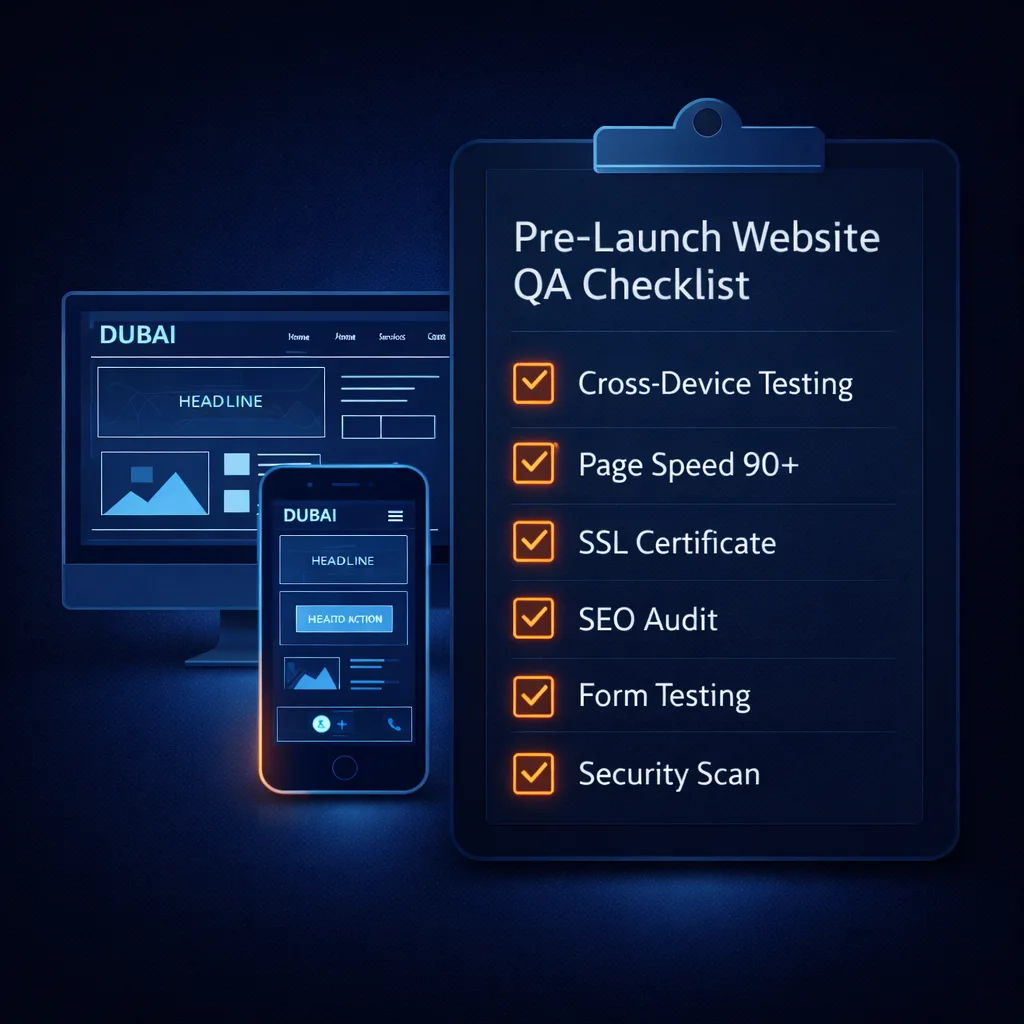
A thorough QA process before launch covers:
Cross-device testing: Your website must render correctly on desktop (Windows and Mac), tablet, and mobile (both iOS and Android) across a range of screen sizes — not just the latest iPhone.
Cross-browser testing: Chrome, Safari, Firefox, and Edge each render websites slightly differently. A page that looks perfect in Chrome can have broken layouts in Safari if the CSS is not properly cross-browser tested.
Form and CTA testing: Every contact form, quote request, WhatsApp button, and booking widget must be clicked, filled in, and submitted exactly as a real customer would. Failed forms mean lost leads.
Page speed audit: Run Google PageSpeed Insights and GTmetrix on every key page — not just the homepage. Confirm no page takes longer than 2–3 seconds to load on a UAE mobile connection.
SEO pre-launch audit: Verify that every page has a unique meta title and meta description, correct H1 tags, canonical tags, a functioning XML sitemap, and a properly configured robots.txt file before the domain is pointed and the site is indexed by Google.
Security scan: Run a full vulnerability check before launch — open ports, outdated plugin versions, default credentials, and insecure file permissions are all launch blockers.
Only when every item on this checklist is confirmed should your live domain be pointed to the new site.
At ProntoSys, every website we build as a professional web development company in Dubai goes through this full QA process before handover — no shortcuts, no rushed launches.
Stage 6: Launch, Google Indexing, and Your First 30 Days Live
Launch day marks the start of a critical 30-day window to establish your website’s search performance baseline and begin building organic visibility. What you do in the first month after going live has a lasting impact on how quickly Google trusts and ranks your new site.
Immediately after launch, your agency should:
- Submit your XML sitemap to Google Search Console and request crawl and indexing for all priority pages.
- Set up Google Analytics 4 with conversion tracking, goal configurations, and traffic source attribution from day one — clean data from the start is invaluable.
- Update your Google Business Profile with the new website URL to ensure local search traffic flows correctly.
- Begin monitoring Core Web Vitals in Search Console using the CrUX (Chrome User Experience Report) for real-world user experience data.
- Start building initial off-page authority through local UAE citations, directory listings on Yellow Pages UAE, Bayut, Dubizzle Business, and relevant industry directories.
- Activate post-launch support — a reputable Dubai agency includes at minimum 30 days of free maintenance to fix any bugs, broken links, or rendering issues that surface after real users start visiting.
The first 30 days are also when your content strategy should begin. Publishing your first few blog posts, optimizing service page content based on early Search Console impressions data, and building your initial backlink profile all happen during this window.
For more on why the choice of agency determines the success of your launch and everything after it, read our guide on why Dubai businesses need a professional web development agency.
Stage 7: Ongoing Website Maintenance — Why It Never Really Ends
Many Dubai businesses make the costly mistake of treating their website as a one-time project. Build it, launch it, forget it. This approach reliably leads to slow-loading pages, security vulnerabilities, lost Google rankings, outdated content, and eventually an expensive rebuild that should never have been necessary.

A website in 2026 is a living digital asset. Like a physical office or retail space, it requires regular upkeep to remain safe, functional, and competitive. Here is what ongoing website maintenance covers for Dubai businesses:
Security updates and patch management: WordPress core, themes, and plugins release updates regularly. Unpatched software is the single most common cause of website hacks, malware injections, and data breaches. Every plugin update is a potential attack vector until it is applied.
Performance monitoring: Page speed, uptime, and server response times need to be reviewed consistently — not just at launch. A site that scored 95 on PageSpeed at launch can drop to 70 within six months if plugins are updated without performance checks.
Regular backups: Daily or weekly automated backups stored off-server ensure that if anything goes wrong — a failed update, a hack, a hosting issue — your website can be fully restored within hours rather than days.
Content updates: Outdated service pages, old pricing, stale blog posts, broken links, and expired promotions all actively damage your SEO rankings and your credibility with visitors. Your website should reflect your current business at all times.
SEO health monitoring: Crawl errors, lost rankings, Core Web Vitals regressions, and algorithm updates all need to be caught and addressed through regular Google Search Console reviews and monthly SEO audits.
Analytics and conversion reviews: Monthly performance reviews tell you which pages are converting, where users drop off, which traffic sources are delivering quality leads, and where your next content investment should go.
Skipping maintenance is not just a technical risk — it is a direct business risk. A hacked or broken website in Dubai loses traffic immediately, but it also loses customer trust, which is far harder to rebuild than a website.
To keep your site secure, fast, and fully operational long after launch, explore our website maintenance packages in Dubai — built specifically for UAE businesses that cannot afford unplanned downtime or security incidents.
Most clients who partner with us as their web development company in Dubai transition directly into a maintenance plan after launch so there is never a gap in protection or performance.
When Should You Upgrade or Rebuild Your Website?
Not every Dubai business needs a full redesign immediately — but there are clear, measurable signals that your current website has reached its limits and is actively costing you business. Here are the most common triggers:
Your Google PageSpeed score is below 60 on mobile. This directly suppresses your search rankings and causes higher bounce rates. Users on UAE mobile networks will not wait for a slow site.
You have outgrown your current CMS. You are limited by templates you cannot customize, plugins that conflict with each other, or a platform that simply cannot scale to your product catalog, service complexity, or multi-location needs.
Your website conversion rate is below 1–2%. Traffic is coming in but not turning into leads or sales. This is a UX and CRO problem that surface-level fixes cannot solve — it needs a structural rebuild.
You are rebranding or expanding into new UAE markets. New brand identity, new services, or expansion into Abu Dhabi, Sharjah, or RAK requires structural changes that go beyond what a simple page update or plugin install can address.
You do not own your website. If your current site is hosted on a rented website builder with no source code access, you are one decision by a third-party company away from losing everything. Full code ownership is non-negotiable.
Your mobile experience is broken or clunky. With over 95% of UAE internet traffic on mobile devices, a site that does not work beautifully on smartphones is losing customers every single day.
If any of these signs apply to your current website, check out our website development packages in Dubai and find the plan that fits your stage of growth and budget.
How to Choose the Right Web Development Company in Dubai
Dubai has hundreds of web development agencies — from individual freelancers on platforms like Upwork to large full-service digital agencies. Here is how to confidently separate reliable long-term partners from those who will overpromise and underdeliver:
Review their live UAE portfolio. Have they built websites for businesses in your industry and your region? Ask for live links and test those sites on mobile right now. If the portfolio sites are slow, broken, or generic, move on.
Ask for Google PageSpeed scores on recent client projects. A credible Dubai web development agency should consistently deliver 90+ PageSpeed scores. If they cannot share verified scores, that tells you everything you need to know about their performance standards.
Verify full code and hosting ownership. You should own your source code and your hosting account from day one. If an agency retains ownership of either, you are at their mercy for every future update, migration, or redesign.
Look for an integrated SEO capability. An agency that understands Dubai SEO will build your site in a way that ranks — with correct URL structures, H-tag hierarchy, schema markup, canonical tags, and mobile-first architecture baked in from the start. Not retrofitted later.
Ask specifically about post-launch support. What happens after delivery? Is there a maintenance plan? An SLA for response times? A dedicated point of contact who knows your account? These details separate professional agencies from project-and-disappear vendors.
Check timeline commitments. Most Dubai business websites should be delivered in four to eight weeks. Anything significantly longer for a standard site is a red flag for process problems or over-stretched capacity.
ProntoSys has delivered 350+ websites for UAE businesses across real estate, retail, healthcare, and professional services — all with full code ownership, Google PageSpeed 95+ scores, and local Dubai support. If you are ready to build or upgrade your website, talk to our web development experts in Dubai for a free consultation and a custom proposal.
Frequently Asked Questions
How long does it take to develop a website in Dubai?
Most professional business websites are completed in four to eight weeks from project kickoff to live launch. More complex websites with custom integrations, eCommerce functionality, or multilingual support may take between eight and twelve weeks. ProntoSys delivers on agreed timelines — we have a 100% on-time delivery track record across 350+ UAE projects.
What is the difference between a website development package and a maintenance package?
A website development package covers the full cost of designing and building your website — it is a scoped, one-time project with a defined set of pages, features, and deliverables. A website maintenance package is an ongoing monthly subscription that covers security updates, backups, plugin management, performance monitoring, and content changes to keep your site healthy and high-performing after launch.
Do I need separate teams for web development and SEO in Dubai?
Not with the right agency. The best approach is to work with a single web development company in Dubai that integrates on-page and technical SEO from the very first build stage — covering site architecture, meta tags, schema markup, page speed, and mobile-first design — so you never have to retrofit SEO onto a structure that was not built for it.
Can I manage my own website content after launch?
Yes. Most Dubai business websites are built on WordPress, which gives you full control over content, images, service pages, and blog posts without any coding knowledge required. ProntoSys also includes training and documentation so your team can make updates independently from day one.
What happens if something breaks after my website goes live?
Every website ProntoSys delivers includes 30 days of free post-launch support to catch and fix any issues that surface after real users start visiting. After that, our website maintenance packages in Dubai cover ongoing security, updates, and support with defined response times so you always have expert help when you need it.
Ready to build a website that works as hard as your business does? Get in touch with ProntoSys — a trusted web development company in Dubai — for a free consultation and a custom proposal built around your business goals, timeline, and budget.

Vijit Tyagi is the CEO and Founder of ProntoSys, a global digital marketing and IT services agency headquartered in Dubai. A B.Tech graduate in Computer Science from Dr. A.P.J. Abdul Kalam Technical University, he brings over 15 years of industry experience. Under his leadership, ProntoSys has expanded across the UAE, UK, and India, becoming a certified Google Partner with a team of 120+ professionals. Tyagi focuses on client-centric digital solutions, ROI-driven strategies, and helping businesses adopt effective digital transformation. He also contributes thought-leadership articles on digital marketing in major publications, emphasizing innovation and growth for modern businesses.