
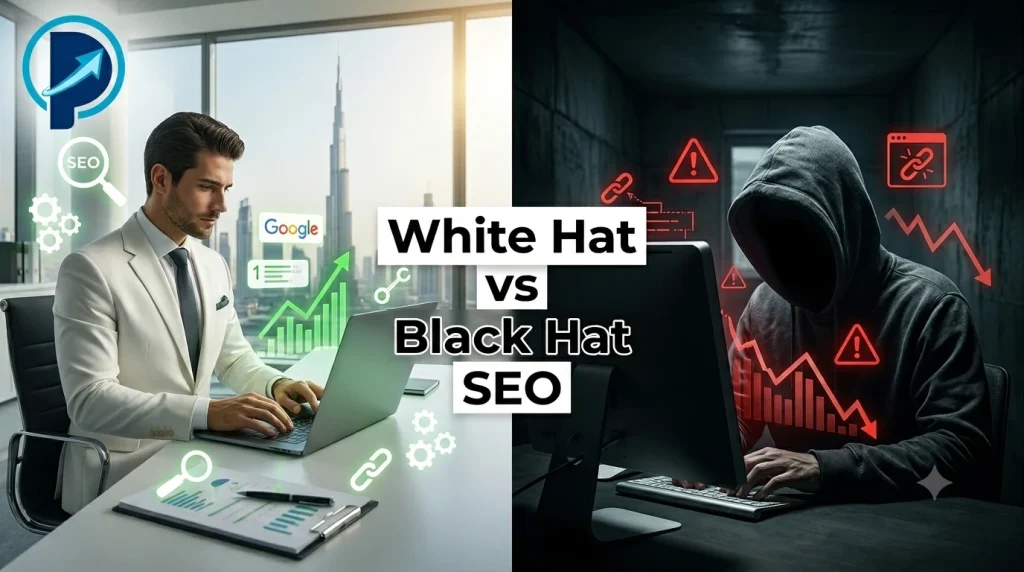
Not saying I want to go full black hat — but I’d be lying if I said I haven’t thought about it.
You’re working late, grinding out quality content, building legit links one by one… and then you check the rankings and see some site with an obviously sketchy link profile sitting right above you. Content that’s worse than yours. User experience that’s borderline offensive. And yet — there it is. Page 1.
If you’ve ever felt that frustration, welcome to the club. And if you’re a Dubai business owner trying to figure out whether to play it safe or play it smart, this blog is exactly for you.
Let’s break down everything — white hat, black hat, what’s changed with AI, and what actually makes sense for your business in 2026.
Table of Contents
Table of Contents
What Is White Hat SEO?
White hat SEO is simply doing SEO the right way. It means following Google’s guidelines, creating content that genuinely helps your audience, building links that are earned — not bought — and making your website a place people actually want to visit.
Think of it like building a restaurant with great food, good service, and honest reviews. It takes time. But people keep coming back, and Google trusts you more with every passing month.
Here’s what white hat SEO looks like in practice:
- Quality content that answers real questions your audience is searching for
- On-page optimization — proper title tags, meta descriptions, headers, and keyword usage that reads naturally
- Technical SEO — fast loading pages, mobile-friendly design, clean site structure, Core Web Vitals
- Natural link building — earning links through guest posts, PR, digital citations, and genuinely shareable content
- Local SEO — optimizing your Google Business Profile, building NAP consistency, collecting real customer reviews
- E-E-A-T signals — showing expertise, experience, authoritativeness, and trustworthiness through your content and site structure
None of these are secrets. They’re just boring, consistent, and they work.
What Is Black Hat SEO?
Black hat SEO is the opposite. It’s the set of tactics that try to game Google rather than satisfy its users. The whole idea is: why earn rankings when you can manipulate them?
It borrows the name from old Western movies and hacker culture — where the “black hat” always plays by his own rules, not society’s.
In SEO terms, black hat practitioners are looking for loopholes in Google’s algorithm. And here’s the uncomfortable truth — those loopholes sometimes work. For a while.
Common black hat tactics include:
- Keyword stuffing — cramming keywords into content until it reads like a robot wrote it for another robot
- Cloaking — showing Google one version of your page and visitors a completely different one
- Link schemes — buying backlinks, joining private blog networks (PBNs), spamming forum comments, fake guest posts
- Hidden text — white text on a white background, tiny fonts, text behind images — tricks meant for algorithms, not humans
- Doorway pages — pages created just to rank for specific queries that then redirect users elsewhere
- Negative SEO — building toxic links to a competitor’s site to tank their rankings (yes, people actually do this)
The thing is, some of these tactics do work — at least temporarily. And that’s exactly what makes them dangerous.
White Hat vs Black Hat SEO: The Real Difference
Here’s the thing most SEO articles won’t tell you: the difference between white hat and black hat isn’t always a clean line. It’s more like a spectrum.
There are still shortcuts and tricks out there. Most of them don’t work the same way old tricks used to — but they accomplish the result you’re looking for. The catch? AI is really good at spotting patterns now. So any trick that works for one person only works as long as they don’t tell anyone else and no one figures out exactly what they’re doing.
By the time someone is willing to share a “trick” publicly, it’s usually because it still sort of works — but it’s already in Google’s pipeline, being quietly identified and prepped for penalization. You’re basically stepping into a trap that hasn’t fully closed yet.
That’s the real risk of black hat in 2026.
White Hat vs Black Hat SEO: Side-by-Side
| Factor | White Hat SEO | Black Hat SEO |
|---|---|---|
| Follows Google guidelines? | Yes — fully compliant | No — deliberately violates them |
| Focus | Real users, long-term value | Algorithm loopholes, quick wins |
| Timeframe | Slow but sustainable results | Fast results, high risk of collapse |
| Content approach | Helpful, original, expert-driven | Thin, duplicate, or AI-spun for volume |
| Link building | Natural, earned, relationship-based | Bought, farmed, or manipulated |
| Risk level | Very low | High — penalties, deindexing, brand damage |
| Brand impact | Builds trust and authority over time | Can permanently damage reputation |
| With algorithm updates | Typically improves or stays stable | Often collapses overnight |
| For Dubai businesses | Safe, scalable, client-presentable | Risky, especially in regulated industries |
| AI’s role | Enhances quality, research, optimization | Being actively used to detect and penalize |
Is White Hat Better Than Black Hat? (Honest Answer)
Yes. But let’s have a real conversation about why.
I’m not sure you’ll find anyone who has had continued success over the years who hasn’t gone at least a bit grey with some of their strategies. There are niches where you genuinely don’t need anything tricky. But in some highly competitive niches, people feel they need to bolster their plan just to get a foothold.
Does that make black hat tactics good? No. But pretending they don’t exist — or that no one uses them — isn’t honest either.
Here’s the business reality for Dubai owners specifically:
White hat wins long-term because:
- Google updates keep getting smarter (especially with AI-driven spam detection)
- One manual action or core update can wipe out years of black hat “progress” overnight
- In Dubai’s competitive markets — real estate, hospitality, finance, e-commerce — brand credibility is everything
- White hat SEO compounds: content gets older and more authoritative, backlinks accumulate, domain authority grows
- Clients and investors ask questions — a site with a toxic backlink profile is a liability
Black hat loses long-term because:
- Those sketchy sites you see ranking above you today? Some of them have already filed quiet appeals after a previous penalty. They’re living on borrowed time.
- Google isn’t just catching patterns now — it’s predicting them. The moment a new trick becomes widespread enough, it gets flagged.
- Dubai’s business landscape is reputation-sensitive. A penalty doesn’t just hurt rankings — it can destroy deals.
Related read:- Effective SEO Strategies to Rank Your Webpages on Google SERP in the UAE: Insights from Prontosys
Is Black Hat SEO Good or Bad?
Bad. Full stop — from a business perspective.
That’s not a preachy answer. It’s a practical one. Black hat SEO is bad because:
- It violates Google’s guidelines — meaning you’re always one update away from losing everything
- It provides zero user value — which means low engagement, high bounce rates, and poor conversion even when it works
- It’s not scalable — you have to keep finding new tricks as old ones die, and it becomes a full-time hustle
- The ROI is deceptive — you might see traffic gains early, then face a penalty that costs 10x what you “saved” on legitimate SEO
For Dubai businesses, there’s an even bigger cost: your Google Business Profile can be suspended, your Ads account flagged, and your overall online presence can take a hit that takes years to recover from.
Also read:- 10 Most Useful SEO metrics that are Important to Track
Why Do People Use Black Hat SEO? (Real Talk)
Because it works — sometimes. And because people are impatient. And honestly? Because some agencies sell it without calling it by name.
Here’s why businesses fall into the black hat trap:
- Desperation for quick results — especially startups or businesses under pressure to “show ROI” in 30 days
- Misleading agencies — plenty of “SEO providers” in Dubai and across the UAE still promise “guaranteed Page 1 results” using tactics they never fully disclose
- Lack of awareness — many business owners simply don’t know the difference until something goes wrong
- Competitive pressure — seeing a competitor ranking well with suspicious tactics can make you want to match them
- Short-term thinking — if someone only needs a site to rank for a few months (say, for a one-time campaign), the risk calculus feels different
The problem is, even “short-term” black hat often creates long-term problems — negative Google flags, toxic backlink profiles that are expensive to clean, and loss of trust with future SEO providers.
Also read:- The SEO Playbook for the Future: How Businesses Can Get Ahead and Stay There
Black Hat SEO Example: What It Actually Looks Like
Let’s make this real with a hypothetical — but very recognizable — scenario.
Imagine a Dubai-based interior design company hires an SEO agency that promises “50 guaranteed backlinks a month.” Sounds great on paper. The agency delivers — but those links come from blog comment spam, irrelevant directories, foreign-language forums, and a PBN the agency quietly controls.
Month 1–3: Rankings go up. The client is happy. The agency gets praised.
Month 4: Google rolls out a spam update. The site drops from Page 1 to Page 4 almost overnight.
Month 5: A manual action is filed. The site is partially deindexed. The client panics.
Month 6–12: The company hires a new agency to do a full link audit and disavow file. They’re rebuilding from scratch.
Total cost: 6–12 months of lost visibility, revenue, and recovery effort — far more expensive than just doing white hat SEO from the beginning.
This is not a hypothetical. This is a pattern that happens regularly, and Dubai businesses are not immune.
Related read:- How to Perform a Manual SEO Audit? Complete Guide in 10 Steps
New White Hat SEO Techniques Driven by AI
Here’s where things get exciting — and where white hat SEO in 2026 looks nothing like it did in 2020.
AI hasn’t just changed black hat tactics. It’s turbocharged what ethical SEOs can do legitimately.
AI-Enhanced Content Strategy
- Topic clustering at scale — AI tools can analyze thousands of queries and group them into semantic clusters, helping you plan an entire content calendar in days rather than months
- Content gap analysis — AI can compare your content to top-ranking pages and identify exactly what you’re missing
- Draft generation + human editing — AI writes a solid first draft; an expert adds real experience, local context (Dubai!), client stories, and the nuance that Google’s E-E-A-T framework rewards
- Conversational content optimization — with voice search and AI Overviews, content written in natural, question-answer format now performs far better than keyword-dense prose
Also read:- Mastering AI: Boost Your Onsite SEO Content Strategy in 2026
AI for Technical SEO
- Automated crawl anomaly detection
- Predicting which pages are at risk before an update hits
- Internal link optimization at scale — AI identifies which pages need more link equity and suggests anchor text distribution
- Core Web Vitals auditing and priority scoring
AI for Local SEO (Big for Dubai)
- Sentiment analysis of Google reviews to identify recurring themes and respond intelligently
- AI-powered GBP post scheduling and optimization
- Local keyword clustering for neighborhood-level or area-specific targeting (Business Bay, JBR, Downtown Dubai)
The key principle: AI is a tool, not a replacement for expertise. White hat SEO in 2026 means using AI to work faster and smarter — not to cut corners.
Related read:- What is Generative Engine Optimization (GEO)? A Complete Guide for UAE Marketers
New Black Hat SEO Tactics Emerging from AI
The same AI revolution that’s helping ethical SEOs is also giving black hat practitioners new ammunition. And Google is in a direct arms race to counter it.
AI-Generated Content Spam
This is the biggest emerging issue. Black hat operators are using large language models to generate thousands of pages of thin, keyword-stuffed content — often spun across multiple domains — to try to capture long-tail traffic at scale.
The content often looks passable on the surface. But it lacks original insight, real experience, and the depth that Google increasingly rewards. Google’s spam detection now specifically targets “scaled content abuse” — and it’s getting better fast.
AI-Assisted Link Schemes
- Automated outreach tools sending thousands of link requests to low-quality sites
- AI-generated guest posts on PBNs that are harder to identify as fake
- Synthetic anchor text variation to try to appear more natural
AI-Powered Cloaking
Some sophisticated operators are using AI to dynamically serve different content — testing which version passes Googlebot’s detection while showing users a different experience entirely.
Here’s the brutal truth: Google trains its spam models on these exact patterns. Every new AI-assisted black hat trick essentially trains the algorithm to catch the next generation of the same trick faster. It’s a losing game, and the losses are getting steeper.
Who Are Black Hat Hackers? (And Why the Name Matters)
Quick context, because this question comes up — especially from business owners new to SEO.
The terms “white hat” and “black hat” come from old American Western films, where the hero always wore a white hat and the villain wore black. The analogy moved into cybersecurity — white hat hackers are ethical security researchers who find vulnerabilities to fix them; black hat hackers exploit those vulnerabilities for personal gain.
In SEO, the same logic applies:
- White hat SEOs find opportunities within Google’s rules and build lasting value
- Black hat SEOs exploit algorithmic loopholes for short-term gain, often at the expense of users and their own clients
Neither group is necessarily a “hacker” in the technical sense — but the ethical framework is identical.
Will AI Replace White Hat Hackers?
This one’s worth addressing briefly because it’s a popular question — especially as AI tools become more capable.
The short answer: No. And here’s why.
AI is excellent at pattern recognition, automation, and processing large datasets. But ethical decision-making, contextual judgment, and relationship-based strategies (things like genuine digital PR, content collaboration, or understanding a Dubai client’s local market nuance) are still deeply human skills.
In cybersecurity and SEO alike, AI will augment white hat professionals — making them faster, more efficient, and more data-driven. But the judgment calls, the creative strategies, and the trust-building will remain human work for the foreseeable future.
White Hat SEO for Dubai Businesses: A Practical Approach
If you’re running a business in Dubai — whether it’s real estate, retail, hospitality, professional services, or e-commerce — here’s what a smart, white hat SEO strategy actually looks like:
Local SEO First
- Fully optimize your Google Business Profile: categories, service areas, photos, posts, and Q&A
- Build consistent NAP (Name, Address, Phone) citations across UAE directories
- Get real, specific reviews from clients — and respond to every single one
- Create content targeting Dubai-specific intent: “best [service] in Dubai”, “[neighborhood] [service] near me”
Also read:- 9 Local SEO Benefits for Your Business in UAE
Content That Demonstrates Expertise
- Blog posts that answer the exact questions your potential clients are Googling
- Case studies using real client results (with permission)
- FAQs structured for featured snippets and Google’s AI Overviews
- Localized landing pages for different areas of Dubai if you serve multiple zones
Technical Foundation
- Fast-loading, mobile-first website (critical in Dubai’s mobile-heavy market)
- Clean URL structure, proper canonicalization, no duplicate content
- Schema markup for local business, products, services, and FAQs
- Regular Core Web Vitals audits
Link Building Done Right
- Contribute to UAE business publications, industry blogs, and local news portals
- Partner with complementary businesses for co-content (not link exchanges — actual collaboration)
- Build your personal and brand authority on LinkedIn — it feeds into E-E-A-T
How to Spot Black Hat SEO Agencies in Dubai (Red Flags Checklist)
Not every agency that uses black hat tactics will tell you. Here’s how to protect yourself:
- ❌ Promises “guaranteed Page 1 results” in a specific number of days
- ❌ Refuses to explain their link-building process in detail
- ❌ Delivers large volumes of backlinks from unrelated or foreign-language sites
- ❌ Reports show dramatic traffic jumps followed by unexplained drops
- ❌ No mention of content strategy, only technical or link deliverables
- ❌ “Secret methods” that they can’t share with you
- ❌ Pricing is suspiciously low with very high promised output
A good SEO agency will explain exactly what they’re doing, why it works, and how it aligns with Google’s current guidelines. Transparency is a feature of white hat SEO — not an inconvenience.
FAQ: Your Questions Answered
What is black and white hat SEO?
White hat SEO is ethical, guideline-compliant optimization focused on user value and long-term rankings. Black hat SEO uses manipulative tactics that violate Google’s rules to gain short-term results, often at the risk of penalties or deindexing.
What is the difference between black hat and white hat SEO?
The core difference is intent and method. White hat focuses on creating value for users within Google’s guidelines. Black hat focuses on exploiting loopholes in the algorithm, regardless of user experience or guidelines compliance.
Is a white hat better than a black hat?
For any legitimate, long-term business — absolutely yes. White hat SEO builds compounding, sustainable visibility. Black hat creates fragile rankings that can disappear overnight.
Is black hat SEO good or bad?
Bad. It violates guidelines, delivers no real user value, and puts your entire online presence at risk. Short-term traffic gains almost never justify the long-term damage.
Why do people use black hat SEO?
Mostly because of impatience, competitive pressure, or being misled by agencies that over-promise. Some niches are more competitive, and the temptation to cut corners is real — but the risk-reward rarely works out in favor of black hat tactics in the long run.
What is white hat SEO?
White hat SEO is the practice of improving your website’s search rankings through ethical, user-focused methods that comply fully with Google’s guidelines — including quality content, legitimate link building, technical optimization, and genuine user experience improvements.
What are new white hat SEO techniques driven by AI?
AI-powered content clustering, semantic gap analysis, automated technical audits, AI-assisted internal linking strategies, and conversational content structured for Google’s AI Overviews are the frontier of ethical AI-driven SEO in 2026.
What are new black hat SEO tactics emerging from AI?
Scaled AI-generated content spam, AI-automated link outreach to low-quality sites, AI-powered cloaking experiments, and synthetic guest post content on PBNs are the most prominent emerging AI-assisted black hat threats.
Final Thought: Choose Your SEO Strategy Like You’re Building a Business — Not Betting on One
Because that’s exactly what it is.
Black hat SEO is gambling with your online presence. Sometimes you win a hand. But the house — in this case Google — always wins eventually. And in Dubai’s competitive, reputation-driven business environment, one penalty at the wrong moment can cost you far more than any ranking boost was ever worth.
White hat SEO is slower. It requires patience, consistency, and genuine expertise. But it compounds. Every good piece of content, every legitimate backlink, every technical improvement adds to a foundation that gets stronger with every algorithm update — not weaker.
Play the long game. Build something that lasts.


